How Can I Improve Work Efficiency?

How Can I Improve Work Efficiency?
One More Hour of Work, One Less Hour of Wasted Work: Maximizing Productivity Through Mindful Time Management
There’s a particular kind of tired that comes from being busy all day—and still feeling behind.
Your calendar was full. Your inbox moved. You handled messages, meetings, quick fixes, and small fires. But the work that actually matters—the work that changes outcomes, builds skills, moves projects forward—stayed untouched. At the end of the day, you’re not just fatigued. You’re frustrated.
In years of journalism, I’ve watched “productivity” get sold as hustle, discipline, and heroic early mornings. Real life is different. Most people don’t need to work harder. They need to work with less friction—fewer interruptions, clearer priorities, and a system that protects deep work.
That’s where Start With One comes in.
Start With One hour reclaimed.
One focused block. One short list. One boundary. One review.
Not to optimize your humanity, just to stop leaking your day.
This guide gives you a practical, human, repeatable approach to productivity, plus answers to the “People also ask” questions that follow this topic everywhere.
The real definition of productivity: outputs that matter, not motion
Productivity isn’t “doing more.” It’s doing what matters with the time and energy you actually have.
A productive day usually has three ingredients:
Focus (time protected from interruptions)
Prioritization (knowing what matters before you start)
Follow-through (finishing, not just starting)
If you want a simple standard:
Did today move my most important work forward?
The Start With One framework for work efficiency
Most productivity systems fail because they’re too complicated to keep. Start With One keeps it survivable:
Start With One:
one “most important task.”
one focus block
one short list of smaller tasks
one maintenance window
one end-of-day reset
You don’t need a perfect day. You need a repeatable one.
High-impact time management strategies that actually work
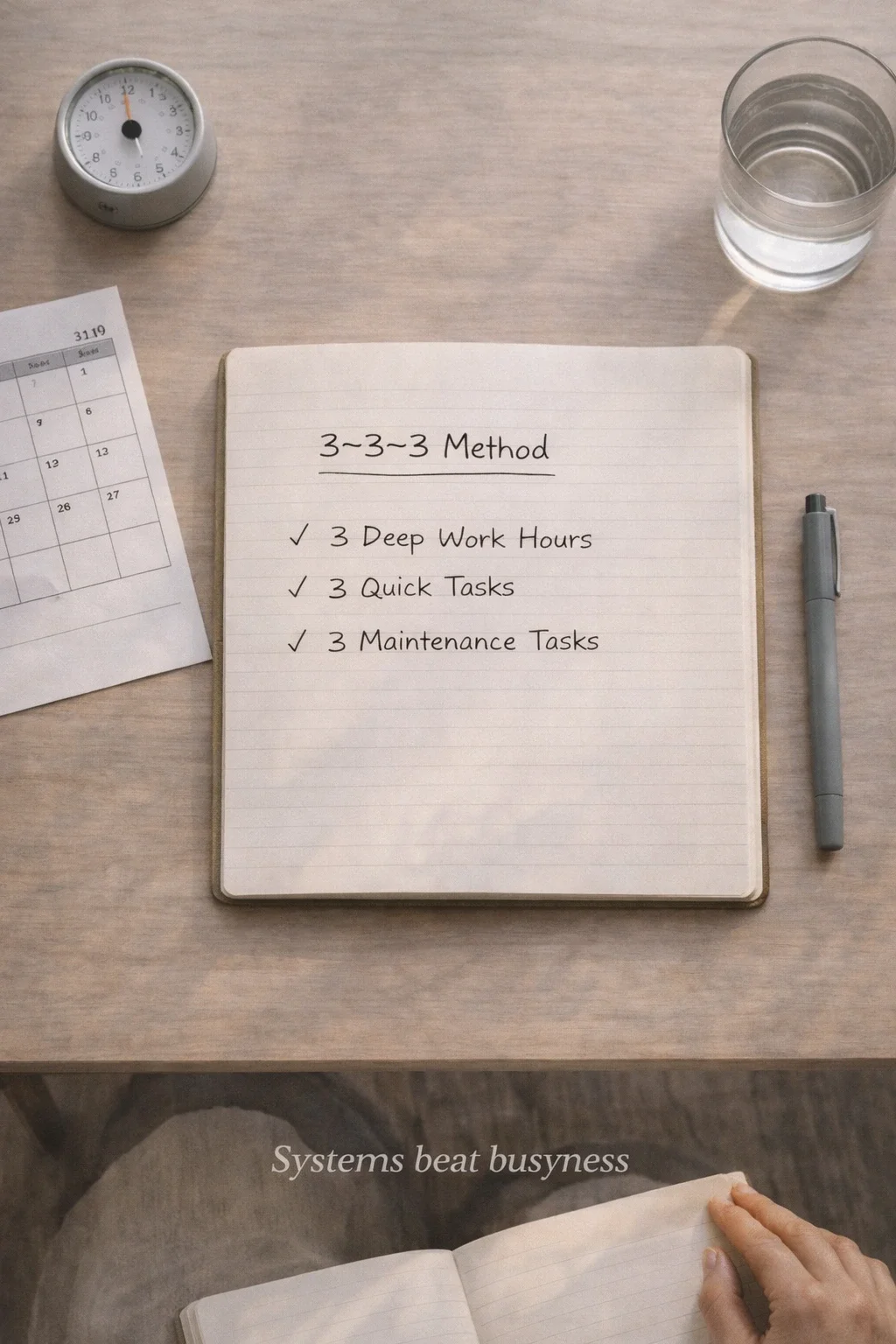
1) The 3–3–3 Method
A clean structure for a chaotic day:
3 hours on your most important work (deep work)
3 shorter tasks you’ve been avoiding
3 maintenance tasks (email, admin, follow-ups)
This is especially powerful for people who feel productive but don’t finish meaningful work.
Start With One: If 3 hours is unrealistic, start with one 45–90 minute block.
2) The 1–3–5 Rule
A practical daily load:
1 big thing
3 medium things
5 small things
It prevents the “infinite to-do list” problem—and forces honest prioritization.
3) Eat the Frog
Do the hardest or most dreaded task first. Not because it’s fun, but because it lowers mental weight and reduces procrastination spirals.
4) Pomodoro
Work in focused sprints (often 25 minutes) with short breaks. Great when motivation is low, or tasks feel overwhelming.
Prioritization frameworks that keep you from doing the wrong work fast
The Eisenhower Matrix (Urgent vs Important)
Urgent + Important: do now
Important, not urgent: schedule
Urgent, not important: delegate
Neither: delete
Most “wasted work” lives in urgent-but-not-important territory.
The 80/20 Rule (Pareto Principle)
Identify the 20% of work producing 80% of results. Then protect time for that 20% first.
Start With One: Ask daily: What’s the one thing that makes other things easier or unnecessary?
Stop leaking your day: focus and environment upgrades
The hidden enemy: context switching
When you bounce between email, chat, meetings, and tasks, your brain pays a switching cost. Even small interruptions create “attention residue,” making deep work harder.
Start With One:
Silence non-essential notifications for one focus block
Close extra tabs
Put your phone in another room for 45 minutes
Design “no-distraction defaults.”
Check email/messages at set times (not constantly)
Use a site blocker during deep work
Keep a clean desk surface (less visual noise)
Tools and automation: use tech to reduce busywork
Task managers: Trello, Asana, Monday (visualize work, track progress)
Automation: Zapier/IFTTT for repetitive workflows
AI support: meeting summaries, first-draft emails, research organization
Start With One: automate one recurring annoyance this week (a template, a shortcut, a recurring checklist).
Manage energy, not just time
Efficiency improves when you work with your natural rhythm:
Find your “prime time” (when your focus is best)
Put deep work there
Put admin work in lower-energy hours
And protect basic foundations:
sleep
hydration
movement
breaks
Start With One: Take one 5-minute walk break at the same time daily. Your brain will thank you.
People Also Ask: quick, clear answers.
What is the 3-3-3 rule for working / for your day / for getting things done?
Most commonly: 3 hours of deep work + 3 quick tasks + 3 maintenance tasks.
It’s a simple structure that prevents a day from becoming pure reaction.
How can I improve my work efficiency?
Pick one from each category:
Focus: one protected deep work block
Planning: one clear daily priority list (1–3–5 works)
Environment: notifications off, fewer tabs
Systems: checklists/templates for repeat tasks
Energy: Schedule hard work when you’re sharpest
Start small. Repeat.
What are the 4 pillars of productivity?
A practical, timeless set:
Clarity (what matters today)
Focus (uninterrupted work time)
Systems (repeatable routines and tools)
Recovery (breaks, sleep, energy management)
What are the 5 goal-setting steps?
Choose the goal (most important outcome)
Define success (measurable “done”)
Break into steps (weekly + daily)
Schedule it (calendar beats intention)
Review and adjust (weekly steering)
What are the 7 steps of goal-setting?
Reflect (what matters this season)
Pick focus areas
Write SMART goals
Identify constraints
Build systems (weekly/daily)
Add accountability
Review weekly, reset monthly
What are examples of goal setting?
“Write 500 words/day for 30 days.”
“Close 10 sales calls/week for 8 weeks.”
“Process email twice daily for 15 minutes.”
“Finish a certification by June with 3 study hours/week.”
What are the 5 smart goals?
SMART isn’t five goals, it's five qualities:
Specific, Measurable, Achievable, Relevant, Time-bound.
What are 5 good personal goals?
Protect sleep (no screens 60 minutes before bed)
Walk 20 minutes 4x/week
Save $500 in 90 days
Read 10 pages nightly
One device-free dinner weekly
What is the 3-3-3 goal-setting?
Often used as: 3 goals for the year, 3 goals for the quarter, 3 priorities for today.
A simplicity rule: fewer targets, more follow-through.
What are the 4 types of goals?
Outcome (results)
Process (habits)
Performance (standards)
Identity (who you become)
Best practice: pair outcome + process.
Management and leadership “C’s/F’s” (why there are so many versions)
These frameworks vary by author, but here are clear, useful versions you can actually apply:
What are the 5 C’s in management?
A practical set:
Clarity (direction and expectations)
Communication (consistent, honest updates)
Coordination (align people and timelines)
Coaching (develop the team)
Consistency (fair standards, follow-through)
What are the 3 C’s of effective leadership?
A strong core:
Clarity (vision + priorities)
Courage (decisions + accountability)
Care (trust + psychological safety)
What is the 30–60–90 rule for managers?
A ramp-up framework:
First 30 days: learn, listen, build relationships
Next 30: contribute, fix quick wins, establish rhythms
Final 30: deliver outcomes, set longer-term strategy
What are the 7 C’s of management?
Commonly framed as:
Clarity, Communication, Commitment, Coordination, Competence, Culture, Consistency.
What are the 6 F’s of leadership?
Varies widely. A useful version:
Focus, Feedback, Fairness, Flexibility, Follow-through, Foresight.
What are the 5 F’s of management?
Also varies. A practical set:
Focus, Forecast, Facilitate, Feedback, Follow-through.
A one-page productivity reset you can start tomorrow
Start With One hour reclaimed (45–60 minutes is enough).
Pick the most important task
Block one focus session on your calendar
Turn off notifications for that block
Write a short “1–3–5” list
End the day with a 5-minute reset: tomorrow’s top priority + first step
Conclusion: efficiency isn’t a personality trait, it’s a practice
You don’t become productive by becoming someone else. You become productive by reducing friction, protecting focus, and building a system you can repeat.
If you’re overwhelmed, don’t rebuild your whole workflow.
Start With One hour.
One clear priority.
One protected block.
One small improvement you can do again tomorrow.
That’s how wasted work shrinks—and meaningful work finally gets the time it deserves.
📘 Get the book: Start With One: Small Steps to a Big Change → a.co/d/5uoSTEJ

🔗 The “One More Hour” Source Shelf — Credible Reads Behind the Productivity Post
IED (7 techniques to increase efficiency at work):
https://www.ied.edu/news/how-to-be-more-productive-7-techniques-to-increase-efficiency-at-workAble (how to improve efficiency at work):
https://able.ac/blog/improve-efficiency/University of Phoenix (burnout + optimizing workspace):
https://www.phoenix.edu/blog/how-to-beat-burnout.htmlTraqq (deep work + time management strategies):
https://traqq.com/blog/how-to-make-time-go-faster-at-work/Zendesk (team productivity strategies):
https://www.zendesk.com/blog/team-productivity/Atlassian (simple ways to be productive at work):
https://www.atlassian.com/blog/productivity/simple-ways-to-be-productive-at-workSahil Bloom (the 3–3–3 method):
https://www.sahilbloom.com/newsletter/the-3-3-3-method-personal-productivity-moreDecluttr Me (the 1–3–5 rule):
https://www.decluttrme.com/blog/using-the-1-3-5-rule-in-your-homeTransformational Leadership Consulting (time management frameworks):
https://transformationalleadershipconsulting.co.uk/blog/the-4ps-of-time-management-master-your-schedule-and-boost-productivity/Asana (productivity at home + task management):
https://asana.com/resources/how-to-be-productive-at-homeRobert Half (boost productivity anywhere):
https://www.roberthalf.com/ca/en/insights/career-development/tips-for-how-to-boost-productivity-no-matter-where-you-work-fromMeisterTask (work efficiency guide):
https://www.meistertask.com/blog/work-efficiencyMarquette University Online (workplace productivity strategies):
https://online.marquette.edu/mba/blog/optimizing-workplace-productivity-strategies-boosting-efficiencyActiveCampaign (habits of highly productive people):
https://www.activecampaign.com/blog/habits-of-highly-productive-peopleIndeed Canada (time management techniques + Eisenhower Matrix):
https://ca.indeed.com/career-advice/career-development/time-management-techniquesCurrentWare (context switching productivity cost):
https://www.currentware.com/blog/tips-for-improving-performance-at-work/BambooHR (increase workplace efficiency):
https://www.bamboohr.com/blog/tips-increasing-workplace-efficiencyIndeed (productivity overview):
https://www.indeed.com/career-advice/career-development/productivityMoveWorks (increase efficiency in the workplace):
https://www.moveworks.com/us/en/resources/blog/how-to-increase-efficiency-in-the-workplaceExecutive Academy (productivity strategies):
https://executiveacademy.at/en/knowledge/career/strategies-to-increase-productivitySlack (improving business productivity):
https://slack.com/blog/collaboration/top-strategies-improving-business-productivityIndeed, Australia (improve work efficiency):
https://au.indeed.com/career-advice/career-development/how-to-improve-work-efficiency