How Can I Increase My Focus?

How Can I Increase My Focus?
One Hour of Focus: Unlocking Your Productivity Sanctuary
Focus used to feel like a personal trait, something you either had or didn’t. In 2026, most of us know better. We’ve watched our attention get pulled apart by notifications, open tabs, meetings, and the subtle anxiety of always being reachable. Then we blame ourselves: Why can’t I concentrate anymore?
But focus isn’t a moral failing. It’s a trainable skill, a “mental spotlight” you can aim, steady, and strengthen over time. And like any skill, it improves faster when you stop trying to overhaul your entire life and instead build one small, repeatable practice. That’s the Start With One approach:
Start With One hour.
Not an eight-hour fantasy. Not a perfectly optimized day. One protected hour where you practice focus the way you’d practice a language or an instrument, deliberately, imperfectly, consistently.
This article gives you immediate tactics, deeper foundations, and a practical system you can start today, without turning productivity into a personality.
The focus myth that keeps people stuck
The myth: If I were disciplined enough, I’d focus.
The reality: focus is often less about discipline and more about environment, energy, and task design.
When your workspace is full of cues to check something else (phone on desk, email visible, chat pings, 19 tabs), your brain isn’t “weak.” It’s responding normally. Many evidence-based focus guides now emphasize the same pattern: reduce distractions, work in timed blocks, and protect foundational habits like sleep and movement.
Start With One Hour: the “Productivity Sanctuary” method.
Think of your focus hour as a sanctuary, an intentionally protected space where the rule is simple: one task, one time block, one finish line.
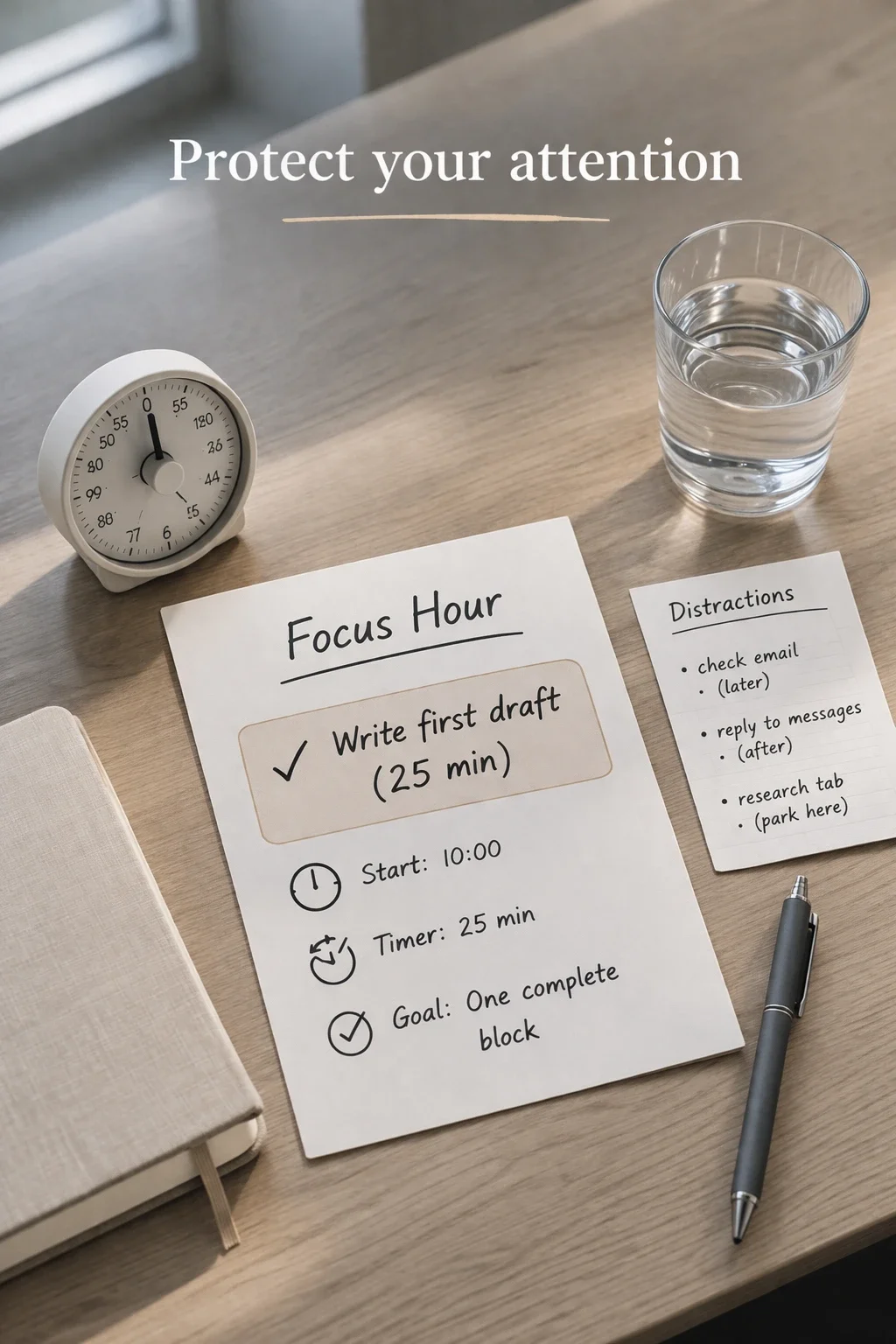
The Focus Hour Setup (5 minutes)
Choose one task that matters (not five).
Define “done” for the hour (a paragraph drafted, a report outline, 20 invoices processed).
Remove the obvious traps: Put your phone out of reach or out of the room
Close email and chat
Reduce tabs to only what you need
Set a timer so your brain knows there’s an end.
This is the Start With One principle in action: you’re not trying to be focused forever, just long enough to finish something meaningful.
Immediate techniques that improve focus today
1) Use the Pomodoro Technique
Work in short, intense bursts (often 25 minutes) followed by a 5-minute break. After four rounds, take a longer break. This reduces mental fatigue and makes starting easier.
Start With One version: Do one 25-minute sprint today.
2) Single-tasking: stop calling context-switching “multitasking.”
Multitasking usually means switching. Switching drains attention and increases errors. Most modern focus guidance emphasizes single-tasking as a foundational skill.
Start With One rule: one screen, one task, one timer.
3) “Parking lot” your thoughts
Your brain will interrupt you with reminders (“email Jim,” “pay bill,” “look that up”). Instead of obeying the thought, write it down on a “distraction list,” so it stops taking up working memory.
Start With One tool: keep a notebook beside you. Don’t fight thoughts; capture them.
4) Visual anchoring (a fast pre-focus ritual)
Focus follows attention. A simple ritual, staring at a fixed point for 60–120 seconds, can act as a transition into deep work for some people. Consider it a “mental doorway” into the task.
Start With One ritual: before you begin, look at one point on your screen or desk, breathe slowly, then start the timer.
Your environment is either helping your focus or stealing it
Put the phone out of sight
A phone on the desk is not neutral, it’s a cue. Many focus resources now recommend physically removing the phone to reduce cognitive load and checking impulses.
Declutter your workspace
A messy desk is a noisy desk. Reduce competing visual inputs: keep only what you need for the current task.
Use sound strategically
Instrumental music, nature sounds, or white noise can help some people sustain focus, while lyrical music may interfere with language-heavy tasks.
Start With One environment move: clear one small surface and silence non-essential notifications for one focus block.
Train focus like a muscle: progressive overload.
If your attention feels “weak,” don’t start with an hour. Start with one minute.
This is progressive overload for the brain:
Day 1: 2 minutes uninterrupted
Day 2: 4 minutes
Day 3: 6 minutes
…and so on.
This works because it builds confidence and tolerance, not just technique.
Start With One truth: consistency beats intensity. Every time you return to the task, you’re training the muscle.
The biological foundations that make focus possible
If your focus is fragile, check the basics before you blame your character:
Sleep: lack of sleep reduces your brain’s ability to filter distractions.
Movement: short walks and regular exercise support attention and mood regulation.
Caffeine: Small amounts can help; too much can increase anxiety and scatter focus.
Start With One foundation: commit to a 10-minute walk daily for one week. It’s small, and often surprisingly effective.
A simple daily focus system you can repeat
This is a grounded routine you can run even on busy days:
Write your top 3 tasks for the day
Choose the single most important one
Do one 25-minute focus sprint (no switching)
Take a 5-minute break
Repeat 2–3 times if you can
Batch email/messages into a short window later
This is how you create a “productivity sanctuary” inside a normal life.
Actionable takeaways you can apply immediately.
Try this today (15 minutes total):
Clear your desk surface
Put your phone out of sight
Write one sentence: “In the next 25 minutes, I will…”
Set a 25-minute timer
Use a distraction list
Stop when the timer ends, leave your brain wanting more
Try this this week:
Schedule one focus hour on your calendar
Protect it like an appointment
Keep the promise,e even if the output is messy
Conclusion: focus isn’t who you are—it’s what you practice
The most empowering truth about attention is also the simplest: it returns when you create conditions for it to return.
You don’t need to become a new person.
You don’t need superhuman discipline.
You need one repeatable act of respect for your own mind.
Start With One hour.
One task. One timer. One sanctuary.
And let that hour become proof that your attention isn’t gone, it’s just been waiting for a quieter place to land.
📘 Get the book: Start With One: Small Steps to a Big Change → a.co/d/5uoSTEJ

🔗 The “One Hour of Focus” Source Shelf — Credible Reads Behind the Blog
Healthline — How to improve concentration:
https://www.healthline.com/health/mental-health/how-to-improve-concentrationReclaim.ai — How to focus (practical focus fundamentals):
https://reclaim.ai/blog/how-to-focusUniversity of Virginia Academic Support — Focus tips:
https://academicsupport.virginia.edu/focus-tipsLinkedIn — Developing focus as a skill:
https://www.linkedin.com/top-content/productivity/improving-focus-techniques/how-to-develop-focus-as-a-skill/BetterUp — Ways to improve focus and concentration:
https://www.betterup.com/blog/15-ways-to-improve-your-focus-and-concentration-skillsYouTube (focus-related reference):
https://www.youtube.com/watch?v=Dk1cJPcaCQkHealthline — How to stay focused:
https://www.healthline.com/health/mental-health/how-to-stay-focusedGoodRx — How to improve concentration:
https://www.goodrx.com/health-topic/mental-health/how-to-improve-concentrationYouTube (deep focus reference):
https://www.youtube.com/watch?v=YWir6BX0MJw&vl=enVerywell Mind — Ways to improve mental focus:
https://www.verywellmind.com/things-you-can-do-to-improve-your-mental-focus-4115389Reddit — Study focus “hacks” discussion:
https://www.reddit.com/r/GetStudying/comments/13ov7g9/whats_a_hack_thats_helped_you_remain_focused/Reddit — Reclaiming ability to focus (community experience):
https://www.reddit.com/r/productivity/comments/6c2hhq/how_i_reclaimed_my_ability_to_focus_after_years/The Guardian — Expert tips to improve focus/concentration:
https://www.theguardian.com/lifeandstyle/2024/oct/18/improve-focus-concentration-span-expert-tipsIndeed — Ways to improve focus at work:
https://www.indeed.com/career-advice/career-development/ways-to-improve-focusReddit — Deep focus tips thread:
https://www.reddit.com/r/productivity/comments/10xsvja/what_are_your_fun_tips_for_getting_into_deep_focus/Zen Habits — Focus:
https://zenhabits.net/focus/Harvard Health — Tips to improve concentration:
https://www.health.harvard.edu/mind-and-mood/tips-to-improve-concentration