How Do You Create a Habit?

How Do You Create a Habit?
Becoming Better Humans Series 2026 — By Start With One
Discipline & Consistency
Build habits, routines, and grit
Includes: 21-Day Consistency Streak
Most people think habits begin with motivation. They don’t.
Habits begin with a moment so ordinary you barely notice it: you reach for your phone before you’re fully awake, you snack while you scroll, you postpone the walk because the weather looks undecided. These aren’t moral failures. They’re patterns—built by repetition, reinforced by rewards, and stored by a brain that loves efficiency.
If you’ve ever asked, “Why can’t I just stick to it?”—you’re asking the right question. The answer isn’t more self-criticism. It’s better design.
A habit is a psychological process: a deliberate action that becomes more automatic over time. James Clear describes the backbone of this process as a four-stage loop—cue, craving, response, reward—a cycle your brain runs because it works. (James Clear)
This post is about building habits the Start With One way: small, intentional steps that create lasting change—without hype, without shame, and without pretending life is frictionless.
The first truth: the “21-day habit” is a myth (but 21 days can still change you)
You’ve heard the line: “It takes 21 days to form a habit.” It’s catchy. It’s also misleading.
A landmark study tracking real-world habit formation found the time to reach automaticity ranged widely—from 18 to 254 days, with an average around 66 days. (Wiley Online Library)
So why use a 21-Day Consistency Streak?
Because 21 days is long enough to prove something more important than “automaticity”:
that you can return to a behavior even when you don’t feel like it
that you can build trust with yourself through repetition
that you can turn a goal into a routine—a stable rhythm you can continue
Think of 21 days as the runway, not the destination.
How habits actually work: the Habit Loop (and why willpower keeps losing)
Every habit—good or bad—follows a predictable sequence:
Cue — a trigger (time, place, emotion, preceding event)
Craving — a desire for a feeling or outcome
Response — the behavior you do (or don’t do)
Reward — the payoff that teaches your brain: repeat this (James Clear)
This matters because most people try to change the response (the behavior) without touching the cue (what starts it) or the reward (what keeps it alive).
If you want a habit to stick, don’t only ask, “How do I try harder?”
Ask, “What’s triggering this—and what payoff am I getting?”
Start With One: the small-step rule that defeats “limbic friction”
There’s a reason you can do something once and still struggle to repeat it: the brain treats new behaviors as expensive.
The simplest way around that is to shrink the behavior until it becomes almost laughably doable—then repeat it until it’s familiar.
Start With One means your habit must be so small it survives bad days.
Examples that work because they’re repeatable:
One minute of stretching (not a full workout)
One paragraph of writing (not a chapter)
One glass of water (not a perfect diet)
One tidy surface (not the whole house)
The goal isn’t to “do it big.” The goal is to show up.
Small actions build identity. Identity builds consistency.
A journalist’s way to build a habit: collect evidence, not inspiration
Here’s a practical, no-fluff method that works across fitness, focus, creativity, and relationships.
1) Make the cue obvious (remove guesswork)
Choose one reliable trigger:
Time: “At 7:00am…”
Location: “When I sit at my desk…”
Preceding event: “After I brush my teeth…” (James Clear)
Write the cue as a sentence:
When X happens, I will do Y.
2) Make the response easy (lower the barrier)
If it takes too much setup, the habit will fail on ordinary days.
Make it easier by designing your environment:
put the book on the pillow
set the water bottle on the counter
lay out the gear the night before
remove one point of friction between you and the behavior (Healthline)
3) Make the reward immediate (teach your brain faster)
Brains learn from what feels satisfying now, not what sounds good later. (James Clear)
Your reward can be simple:
check a box on a tracker
a “done” note in your phone
a short satisfying ritual: tea, music, a two-minute walk outside
a quick message to yourself: “I keep promises to me.”
The consistency secret most people miss: you’re building a system, not a mood
Motivation is weather. Systems are climate.
A reliable habit plan includes:
a minimum version (the “bad day” habit)
a normal version (your typical routine)
an upgraded version (when you have energy)
Example: walking
Minimum: put on shoes + step outside
Normal: 10 minutes
Upgraded: 30 minutes
This is how you build consistency without perfectionism: you always have a version you can complete.
If you have ADHD (or a loud brain): design for immediate rewards, not guilt
Some brains don’t respond well to delayed gratification. That’s not weakness—it’s wiring.
The ADDA notes that immediate rewards can be especially helpful when building habits, because the brain is more likely to repeat what feels satisfying right away. (ADDA)
So if you’ve struggled with routines:
keep the habit tiny
keep the reward immediate
keep the tracking visible
keep the plan flexible—but the cue consistent
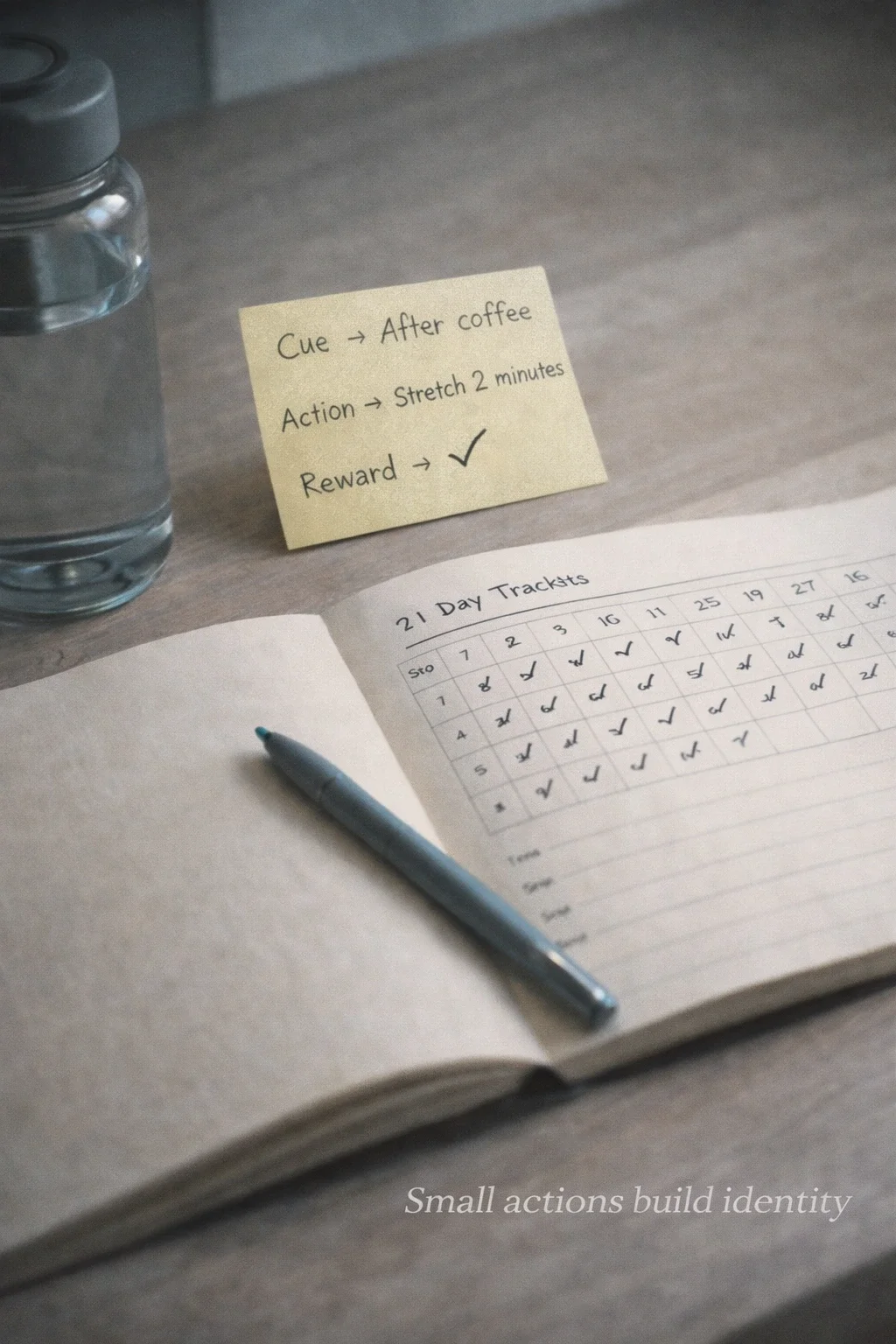
The 21-Day Consistency Streak
Discipline & Consistency — Start With One
This is not a “21 days to automatic” promise.
This is a 21-day proof-of-practice.
Step 1: Choose ONE habit (not five)
Pick something that would genuinely improve your life if done consistently:
2 minutes of movement
1 page of reading
5 minutes of tidying
one outreach message
one mindful pause before your first scroll
Step 2: Write your habit sentence
After/When ________, I will ________ for ________.
Example:
After I make coffee, I will stretch for 2 minutes.
Step 3: Use the “never miss twice” rule
If you miss a day, you don’t restart your identity. You restart tomorrow.
Missing once is life. Missing twice is a pattern.
Step 4: Track it (keep it embarrassingly simple)
Day 1–21: YES / NO
Optional reflection (one line):
What helped today? What got in the way?
Actionable takeaways you can use today
If you only do three things, do these:
Shrink the habit until it’s too easy to fail.
Anchor it to a cue you already do daily.
Reward it immediately (track it, celebrate it, close the loop). (James Clear)
People Also Ask: Habit Building FAQs
What is the 3-3-3 rule for habits?
The 3-3-3 rule is a rule of thumb used to set expectations: the first 3 days are the hardest, the first 3 weeks start to feel more familiar, and after about 3 months the behavior feels more integrated. It’s not a scientific guarantee—but it can be a helpful mental model for staying patient when the habit still feels “new.” (Psychology Today)
Start With One translation: Don’t judge a habit in the first 3 days. That’s the “friction phase.”
What is the 21/90 rule for habits?
The 21/90 rule is another popular guideline: around 21 days to make a behavior feel like a routine, and around 90 days to make it feel more like a lifestyle. It’s widely repeated because it’s simple—but it’s not a universal science-based timeline for automatic habits. (Nutrition News)
Start With One translation: Use 21 days to build proof of practice—then keep going.
How do you create a habit?
A reliable, science-aligned approach is to build around the habit loop (cue → craving → response → reward) and reduce friction:
Choose a clear cue (time, place, or “after X”)
Make the action tiny (so it survives bad days)
Make it easier (environment design: prep, remove barriers)
Add an immediate reward (track it, celebrate it, close the loop)
Repeat, and if you slip: never miss twice
Real-world research shows habit automaticity varies widely, commonly ranging 18–254 days, averaging around 66 days, depending on the person and behavior. (James Clear)
What are the 7 daily habits?
There isn’t one official list (and there shouldn’t be—your life is not a template). But if you want a strong “foundations” set that supports most people, here’s a practical seven that’s easy to personalize:
Move for 2–10 minutes (walk, stretch, mobility)
Hydrate (one glass early)
Plan one priority (the “one thing” you’ll finish)
Protein/produce anchor (add one healthy element)
Connection touchpoint (text/call/check-in)
Tidy one small zone (desk, counter, bag)
Downshift ritual (screens off cue, breathe, journal line)
Start With One rule: pick one of the seven to start, not all seven.
What are 10 good habits?
Again—no universal list. But here are 10 “high-return” habits that tend to improve energy, focus, relationships, and resilience across different lifestyles:
Consistent sleep/wake window
Daily movement
Strength or resistance work 2–3x/week
Hydration habit
Whole-food “add before subtract” (add fruit/veg first)
10 minutes of reading/learning
A daily planning check (1 priority + 1 boundary)
A gratitude or “win” line (identity reinforcement)
Weekly review (what worked, what didn’t, what’s next)
A “digital fence” (no-scroll zones/times)
What is the #1 worst habit for anxiety?
There isn’t one single “worst habit” for everyone, but one of the most common anxiety amplifiers is avoidance—the habit of escaping discomfort in the short term (putting off the call, dodging the task, not opening the message). Avoidance brings temporary relief, which reinforces the pattern—while the underlying stress grows.
A close second: compulsive checking (news, email, socials, symptoms), which can keep the nervous system on alert by repeatedly signaling “something might be wrong.”
Start With One antidote: don’t “fix your anxiety.” Name one tiny action you can complete anyway. Tiny exposure + tiny completion builds trust.
If you want, I can also format this into StartWithOne.ca blog styling (short paragraphs, punchy subheads, skimmable bullets), and add a final section called:
“Start With One: Your 21-Day Consistency Streak (Printable Checklist)”
…so it becomes both search-friendly and action-ready.
Conclusion: the habit you’re really building is self-trust
A good habit doesn’t just produce results. It produces a person—someone who keeps showing up.
And that’s the deeper promise of Start With One: not dramatic reinvention, but steady evidence. Small actions that become a reputation you build with yourself.
You don’t need a perfect plan.
You need a repeatable one.
Start With One.
Then do it again tomorrow.
📘 Get the book: Start With One: Small Steps to a Big Change → a.co/d/5uoSTEJ

🔗 Habit Science Source Kit (Start With One)
James Clear — The 3 steps of habit change (habit loop concepts)
https://jamesclear.com/three-steps-habit-changeJames Clear — Atomic Habits summary (Four Laws of Behavior Change)
https://jamesclear.com/atomic-habits-summaryJames Clear — How to start a new habit
https://jamesclear.com/new-habitEuropean Journal of Social Psychology — How long habits take (18–254 days, ~66 avg)
https://onlinelibrary.wiley.com/doi/10.1002/ejsp.674Healthline — The science of habit (behavior + brain basics)
https://www.healthline.com/health/the-science-of-habitADDA (Attention Deficit Disorder Association) — Changing habits (ADHD-friendly support)
https://add.org/changing-habits/Western University (Thrive) — The science behind habits (brain forms/breaks habits)
https://uwo.ca/se/thrive/blog/2024/the-science-behind-habits-how-the-brain-forms-and-breaks-them.html