How Do You Plan and Set Your Goals?

How Do You Plan and Set Your Goals?
One More Plan: Charting Your Path to Success through Daily Planning
Most people don’t fail at goals because they lack ambition. They fail because they confuse hope with a plan, and a plan with a life.
Hope is saying, “This year will be different.”
A plan is deciding what “different” looks like—and what you’ll do on ordinary Tuesdays to get there.
A life is what happens while you’re trying.
After decades of interviewing high performers, everyday people in hard seasons, and experts who live in the gap between intention and reality, one pattern holds: sustainable progress comes from clarity, constraints, and consistent review—not hype.
That’s why Start With One is so effective. It removes the pressure to reinvent yourself overnight and replaces it with a quieter form of power:
Start With One plan. One action. One check-in.
Then repeat until the goal stops feeling like a wish and starts feeling like a direction.
Below is a practical, timeless system for planning and setting goals—plus answers to the “People also ask” questions that show up right alongside goal-setting searches.
Step Zero: Plan from identity, not anxiety
Before you write a goal, ask a deeper question:
Who do you want to be when nobody is watching?
Goals built from anxiety tend to be loud and brittle—chasing status, urgency, or someone else’s timeline. Goals built from identity are steadier. They survive busy weeks and bad moods because they’re tied to the person you’re choosing to become.
Start With One prompt:
Finish this sentence: “In the next 12 months, I want to become someone who…”
Examples:
“…keeps promises to myself.”
“…protects my health as it matters.”
“…handles money with calm and clarity.”
“…creates consistently.”
1) Start with reflection: the honest audit
Planning works best when it begins with truth, not optimism.
Take 10 minutes and answer:
What worked last year—and why?
What drained you more than expected?
Where did you grow up?
What do you want more of (time, energy, learning, connection)?
What do you want less of (stress, clutter, scrolling, overspending)?
This creates themes. Themes become priorities. Priorities become goals.
Start With One move: Write three sentences:
“This year I’m proud that I…”
“This year I learned that I…”
“Next year I need more…”
2) Choose 2–4 life areas so your goals don’t compete
A common failure mode is having too many “important” goals. Your calendar can’t hold them all.
Choose 2–4 categories for the season you’re in:
Work / Business
Health / Energy
Money / Stability
Relationships / Home
Personal growth / Learning
Start With One rule: If everything matters, nothing gets done. Pick fewer. Go deeper.
3) Set SMART goals that your future self can measure
A goal should be specific enough that a stranger could tell if you completed it.
Use SMART:
Specific: What exactly will you do?
Measurable: How will you track it?
Achievable: Is it realistic for your current season?
Relevant: Does it match your values and “North Star”?
Time-bound: By when?
Example (money): “Save $2,000 by Dec 31 via $167 monthly auto-transfers.”
Example (health): “Walk 8,000+ steps 5 days/week for 12 weeks.”
Example (work): “Publish 2 videos/week for 90 days.”
Start With One upgrade: Rewrite any goal until “done” is unmistakable.
4) Turn goals into systems: the daily plan that actually wins
Goals are destinations. Systems are transportation.
The most overlooked question in goal setting is:
What will I do weekly that makes this outcome likely?
Try this structure:
Quarterly checkpoints (every 90 days)
Break the year into four seasons. Most people can focus for 90 days far better than 365.
Example: If your annual goal is “write a book,” your Q1 checkpoint might be “outline + 20,000 words.”
Weekly commitments (the real engine)
Choose 1–3 weekly actions you can keep even when life is busy:
Two gym sessions
One meal prep block
Three sales calls
One long writing session
One “budget meeting” with yourself
Daily micro-actions (2–15 minutes)
Micro-actions eliminate the friction that kills momentum:
Write 100 words
Walk 10 minutes
Review spending for 3 minutes
Read 2 pages
Practice for 5 minutes
Start With One principle: If you can’t do it on a hard day, it’s not a system—it’s a fantasy.
5) Add “anti-goals” to protect your plan
Anti-goals are boundaries that keep your goals alive.
Examples:
“No social media before my first work block.”
“No meetings after 4 p.m. twice a week.”
“No impulse buys after 9 p.m.”
“No saying yes immediately—everything gets a 24-hour pause.”
Start With One move: Choose one anti-goal that protects your energy.
6) Schedule reviews so you don’t drift
Goals don’t fail in one day. They fade through weeks of unexamined drift.
Put these on your calendar:
Weekly (10 minutes): What moved? What stalled? What’s the next small step?
Monthly (30 minutes): Are my actions matching my priorities?
Quarterly (60 minutes): What needs to change based on real life?
Start With One reframe: A review is not a judgment. It’s a steering wheel.
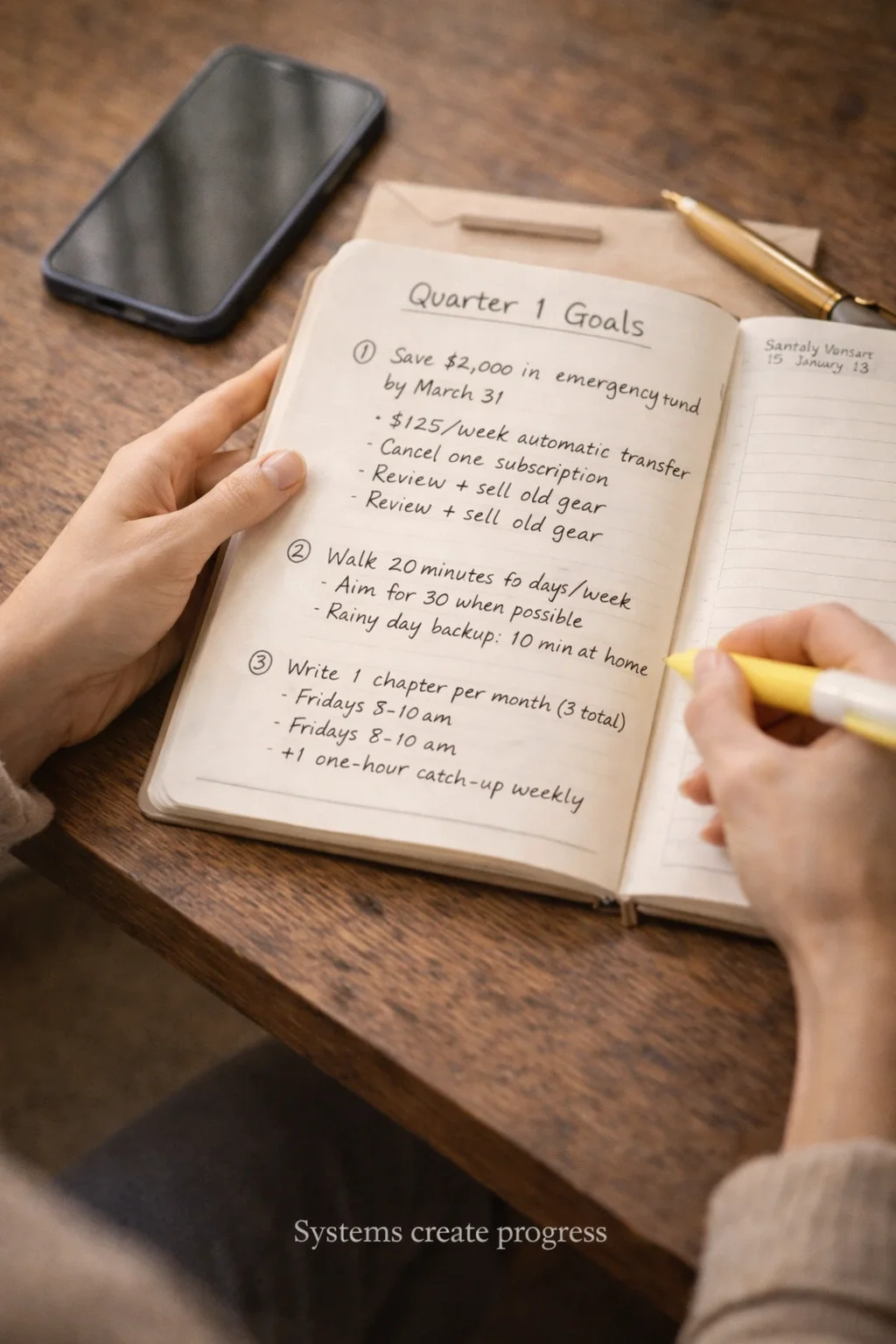
People Also Ask: Quick Answers (Clear, useful, real-life)
How do you plan and set goals?
A reliable method:
Reflect on what matters and what you’re avoiding
Choose 2–4 life areas
Set 1–2 SMART goals per area
Build weekly systems + daily micro-actions
Review weekly and adjust monthly
If your plan doesn’t show up on your calendar, it’s not a plan yet.
What is the 3-3-3 rule for goals?
There are a few versions online. Here’s a practical one that works:
3 goals for the year (the big focus)
3 goals for the quarter (the next 90 days)
3 daily priorities (today’s proof)
It’s a simple rule: fewer targets, more execution.
What are the 5 F’s of goal setting?
Different coaches define these differently. A useful, memorable version:
Focus — pick what matters most
Frame — define what “done” looks like
Fuel — identify your why and supports
Follow-through — systems, not motivation
Feedback — review, learn, adjust
What are the 5 steps in planning a goal?
Define the outcome (specific + measurable)
Set a deadline
Break it into milestones
Schedule weekly actions
Track progress and revise as needed
What are 10 examples of goals?
Save $1,000 emergency fund in 90 days
Pay off $3,000 credit card debt by Dec 31
Walk 30 minutes, 4 days/week for 12 weeks
Strength-train 2x/week for 3 months
Read 12 books this year (1/month)
Finish a professional certification by September
Apply to 20 roles in 30 days
Launch a weekly newsletter for 90 days
Meal prep every Sunday for 8 weeks
Have one device-free evening per week for 3 months
What are the 7 steps to plan your goals?
Reflect (what matters now?)
Choose categories (2–4)
Set SMART goals
Define success metrics
Build systems (weekly + daily)
Add boundaries (anti-goals)
Review and adjust (weekly/monthly)
Actionable takeaways you can use today
Try the “One More Plan” method (15 minutes):
Write one goal you care about
Make it measurable + time-bound
Decide the smallest daily action (2–10 minutes)
Put it on tomorrow’s calendar
Schedule a 10-minute weekly review
That’s it. One plan. One action. One review.
Conclusion: Your goal isn’t your life—your life is the point
Goals are useful because they give shape to your days. But they’re not the measure of your worth. They’re a tool for living with intention.
If you’ve been overwhelmed, restart gently. Not with a complete reinvention—just a clear next step.
Start With One plan.
One small action. One honest check-in.
Then let consistency do what motivation never could.

🔗 The “One More Plan” Source Shelf — Credible Reads Behind the Goal-Setting Guide
SMU Academy (goal-setting insights): https://academy.smu.edu.sg/insights/goal-setting
Growth Space (reflective goal setting for 2026): https://growth-space.co.uk/blog/reflective-goal-setting-for-2026-a-guide-for-personal-growth-and-wellbeing
The Globe and Mail (reflection questions to plan): https://www.theglobeandmail.com/business/careers/talent/article-vision-2026-12-reflection-questions-to-complete-the-year-and-plan/
Sahil Bloom (annual planning guide): https://www.sahilbloom.com/newsletter/the-annual-planning-guide
RealAtlas (real estate goals framework): https://realatlas.com/real-estate-goals-atlas-real-estate/
Realtor.com (goal-setting blueprint for real estate growth): https://www.realtor.com/marketing/resources/the-ultimate-goal-setting-blueprint-to-grow-your-real-estate-business/
Avenue Transactions (2026 real estate goals + leverage): https://www.avetransactions.com/blog/setting-your-2026-real-estate-goalsand-the-leverage-youll-need-to-reach-them
Forrest Hanson (a better system for reaching goals): https://forresthanson.substack.com/p/a-better-system-for-reaching-your
YouTube (supporting video reference used in planning examples): https://www.youtube.com/watch?v=XYfsaWDoMmg