How to Start Journaling?
How to Start Journaling?
One Journal Entry: Your Daily Journey to Personal Growth
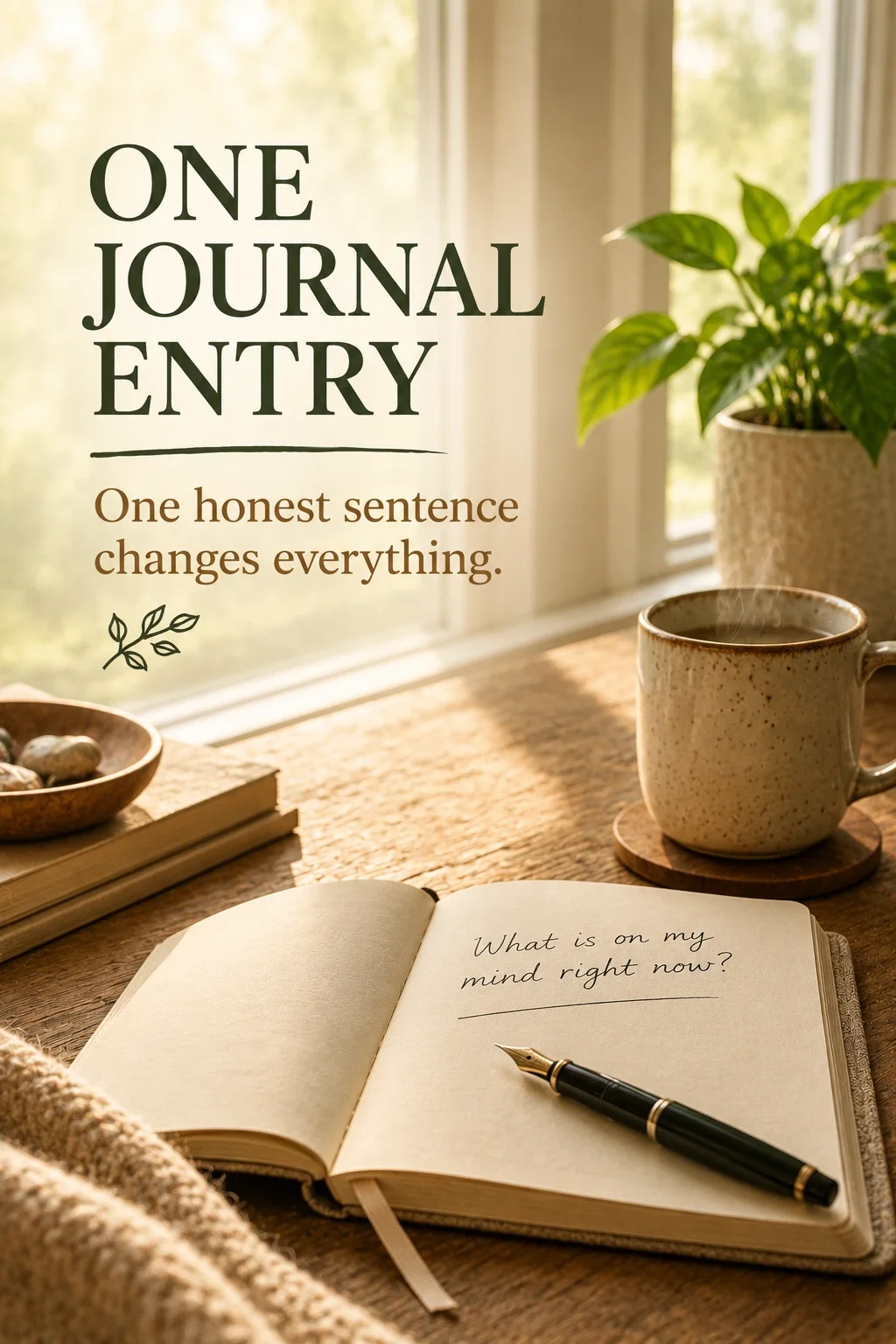
The best way to start journaling is to write one honest entry for five minutes using a simple prompt. Choose a notebook or digital note, pick one repeatable time, and begin with this question: “What is on my mind right now?” Journaling works best when it becomes a private practice of clarity, not a performance.
A blank page can feel intimidating.
It seems to ask for something profound. A perfect insight. A beautiful sentence. A life-changing confession. But journaling does not need to be polished, poetic, or even organized.
Journaling is not publishing.
It is listening.
It is a place to slow down your thoughts, name what you are feeling, notice what keeps repeating, and identify one small step forward.
The Start With One approach is simple:
Do not try to write your whole life story.
Start with one sentence.
One question.
One truth.
One journal entry.
Why Journaling Helps
Journaling helps because it moves thoughts out of your head and onto the page.
A worry that stays in your mind can feel endless. Written down, it becomes more specific. Once it is specific, you can understand it, question it, or decide what to do next.
Journaling may help you:
Reduce mental clutter
Manage stress
Understand emotions
Track patterns
Clarify goals
Process challenges
Practise gratitude
Make better decisions
Notice personal growth over time
It is not magic. It does not replace therapy, medical care, or support from people you trust. But it can become a practical daily tool for self-awareness and emotional clarity.
A journal gives you a private room for the truth.
How Do Beginners Start Journaling?
Beginners should start small.
Do not begin with a complicated system. Do not buy the perfect notebook, create twelve categories, or promise yourself you will write every day forever.
Start with five minutes.
Open a notebook or digital note and answer:
What is on my mind right now?
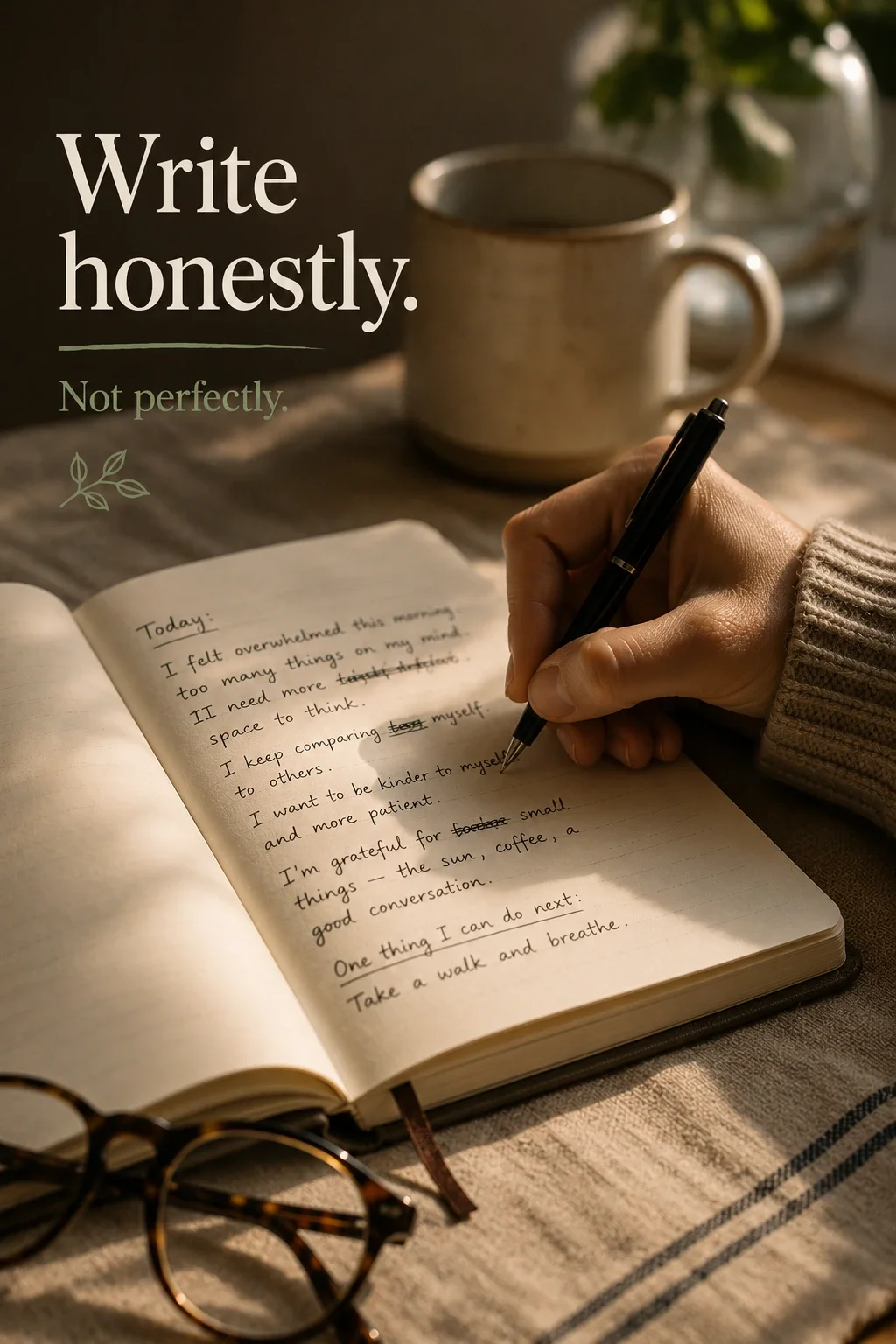
Write in fragments if you need to. Use bullets. Misspell words. Repeat yourself. Stop mid-sentence.
The goal is not good writing.
The goal is honest writing.
A Simple First Entry
Try this:
Today I feel:
What is on my mind:
What I need:
One thing I can do next:
Example:
Today I feel: tired but hopeful.
What is on my mind: work, money, and a conversation I keep replaying.
What I need: a little space to think clearly.
One thing I can do next: take a walk and send the message I have been avoiding.
That is journaling.
Not perfection.
Not performance.
Just one honest check-in.
What Should I Write in a Journal?
Write what helps you see your life more clearly.
You can write about:
What you are feeling
What you are worried about
What you are grateful for
What you learned today
What you want to remember
What decision you are facing
What gave you energy
What drained you
What you want to do differently
What one small step you can take next
There is no single correct style.
Some people write full paragraphs. Others use bullet points. Some write prayers, goals, business ideas, dreams, questions, or daily reflections.
The best journal is the one you will actually return to.
What Is the 3-3-3 Method of Journaling?
The 3-3-3 method is a simple structure for people who do not know what to write.
Write:
3 thoughts on your mind
3 feelings you notice
3 next steps you can take
Example:
3 thoughts: I have too much to do. I am worried about money. I need more sleep.
3 feelings: anxious, tense, impatient.
3 next steps: pay one bill, take a short walk, go to bed earlier.
This method works because it turns mental clutter into visible information.
It helps move you from overwhelm to awareness, and from awareness to action.
What Is the 3-2-1 Method of Journaling?
The 3-2-1 method is useful for daily reflection.
Write:
3 things you learned
2 things you appreciated
1 thing you will focus on next
Example:
3 things I learned: I need more preparation time. I focus better after walking. I avoid hard tasks when I am tired.
2 things I appreciated: a quiet coffee and a kind message.
1 focus: start tomorrow with the most important task first.
This method is helpful because it gives the day a clean ending.
It does not just record what happened. It helps you extract meaning from it.
Why Do I Struggle to Journal?
Most people struggle to journal because they make it too big.
You may struggle because:
You do not know what to write
You expect every entry to be meaningful
You judge your grammar or handwriting
You worry someone will read it
You are afraid of what might come up
You only journal when overwhelmed
You start with a routine that is too hard to maintain
The solution is to lower the pressure.
Try this rule:
Never write more than you can repeat tomorrow.
If five minutes is sustainable, five minutes is enough.
If one sentence is all you can write, one sentence counts.
Consistency grows from small beginnings.
What Is the Dark Side of Journaling?
Journaling can become unhelpful when it turns into rumination.
Rumination means circling the same painful thought again and again without gaining insight, relief, perspective, or action.
Warning signs include:
You feel worse after every entry
You keep writing the same painful story without movement
You use the journal to criticize yourself
You avoid real conversations or support
You treat every thought as absolute truth
You analyze the past but never identify a next step
The answer is not always to stop journaling.
It may be to add structure.
After writing about something difficult, close with one question:
What do I need now?
What is one small next step?
What would I say to a friend in this situation?
What part of this is within my control?
Be honest on the page.
But do not use the page as a weapon against yourself.
What Not to Do When Journaling
Do not turn your journal into another place where you have to perform.
Avoid these common mistakes:
Do not wait for the perfect notebook
A plain notebook works. A notes app works. A scrap of paper works.
The habit matters more than the tool.
Do not write for an audience.
Your journal is private. You do not need to sound wise, impressive, or inspirational.
Do not force positivity.
Gratitude is useful, but it should not become denial. You can be thankful and still be tired, hurt, confused, or frustrated.
Do not only vent
Venting may release pressure, but reflection creates direction. After venting, ask what you need or what one action could help.
Do not make the habit too large.
A 30-minute plan may sound powerful, but a five-minute practice is easier to repeat.
Five Easy Journal Prompts for Beginners
Use one prompt at a time.
1. The Brain Dump
What is taking up space in my mind right now?
2. The Emotional Check-In
What am I feeling, and where do I feel it in my body?
3. The Gratitude Entry
What are three small things I appreciated today?
4. The Lesson Entry
What did today teach me?
5. The Next-Step Entry
What is one thing I can do tomorrow to make life slightly better?
These prompts are simple enough to use even when you do not feel inspired.
That is the point.
A good journaling habit should work on ordinary days.
A Start With One Journaling Plan
Try this for seven days.
Day 1: One Sentence
Write one sentence about how you feel.
Day 2: One Gratitude
Write one thing you appreciated today.
Day 3: One Worry
Write one worry and one action you can take.
Day 4: One Lesson
Write what today taught you.
Day 5: One Win
Write one thing you did well.
Day 6: One Question
Write the question you keep avoiding.
Day 7: One Next Step
Write one small action for tomorrow.
At the end of the week, do not grade yourself.
Notice what showed up.
What repeated?
What gave you energy?
What felt heavy?
What became clearer?
What step kept asking for your attention?
That is growth.
Not instant transformation.
A clearer relationship with your own life.
Frequently Asked Questions
How do beginners start journaling?
Beginners should start with five minutes, one simple prompt, and no pressure to write well. Open a notebook or digital note and answer: “What is on my mind right now?”
What is the 3-3-3 method of journaling?
The 3-3-3 method means writing three thoughts, three feelings, and three next steps. It helps organize mental clutter and turn reflection into action.
What is the 3-2-1 method of journaling?
The 3-2-1 method means writing three things you learned, two things you appreciated, and one thing you will focus on next.
Why do I struggle to journal?
You may struggle because the blank page feels intimidating, the habit feels too big, or you expect your writing to be meaningful every time. Start smaller. One honest sentence is enough.
What is the dark side of journaling?
The dark side is rumination: repeatedly writing about painful thoughts without insight, support, or next steps. Add closing prompts that move you toward care, perspective, or action.
What should you not do when journaling?
Do not write for an audience, force positivity, obsess over grammar, judge your honesty, or use journaling only to criticize yourself. The page should create clarity, not pressure.
One Page Can Become a Mirror
A journal will not live your life for you.
It will not make the decision, heal the wound, finish the project, repair the relationship, or choose the path.
But it can help you see.
It can show you what you keep carrying.
What you keep avoiding.
What you keep wanting.
What you keep learning.
What one step is waiting in front of you.
You do not need to write the story of your whole life tonight.
Start smaller.
One sentence.
One question.
One gratitude.
One truth.
One next step.
Start With One journal entry. Your daily journey to personal growth begins on the page in front of you.
📘 Get the book: Start With One: Small Steps to a Big Change → a.co/d/5uoSTEJ

From Blank Page to Breakthrough: Sources Behind “How to Start Journaling”
University of Rochester Medical Center — Journaling for Mental Health
https://www.urmc.rochester.edu/encyclopedia/content?ContentID=4552&ContentTypeID=1UCLA / Semel Institute — Putting Feelings Into Words and Emotional Regulation
https://teams.semel.ucla.edu/node/4368PubMed — Expressive Writing, Health and Emotional Processing Research
https://pubmed.ncbi.nlm.nih.gov/22209127/Child Mind Institute — The Power of Journaling
https://childmind.org/blog/the-power-of-journaling/Healthline — Benefits of Journaling and How to Start
https://www.healthline.com/health/benefits-of-journalingPositive Psychology — Benefits of Journaling
https://positivepsychology.com/benefits-of-journaling/Simply Psychology — Journaling for Mental Health
https://www.simplypsychology.com/articles/journaling-for-mental-healthSchool Mental Health Ontario — Journaling 101
https://smho-smso.ca/journaling-101/Kaiser Permanente — Benefits of Keeping a Journal
https://healthy.kaiserpermanente.org/health-wellness/healtharticle.7-benefits-of-keeping-a-journalReflection App — Benefits of Journaling
https://www.reflection.app/blog/benefits-of-journalingBetterUp — How to Start Journaling
https://www.betterup.com/blog/how-to-start-journalingStart With One — Source Book Inspiration
Start With One: Small Steps to a Big Change
Relevant theme: “One Journal Entry: Your Daily Journey to Personal Growth”