What Are The SMART Goals Examples?

What Are The SMART Goals Examples?
One More Goal: Navigating Life’s Journey with Daily Purpose
If you’ve ever written a goal that sounded inspiring—get healthier, save more, grow my business—and then watched it dissolve by February, you’re not alone. In three decades of journalism, I’ve interviewed people who build companies, rebuild lives, recover from setbacks, and quietly reinvent themselves without anyone noticing. Their secret isn’t superhuman willpower.
It’s specificity.
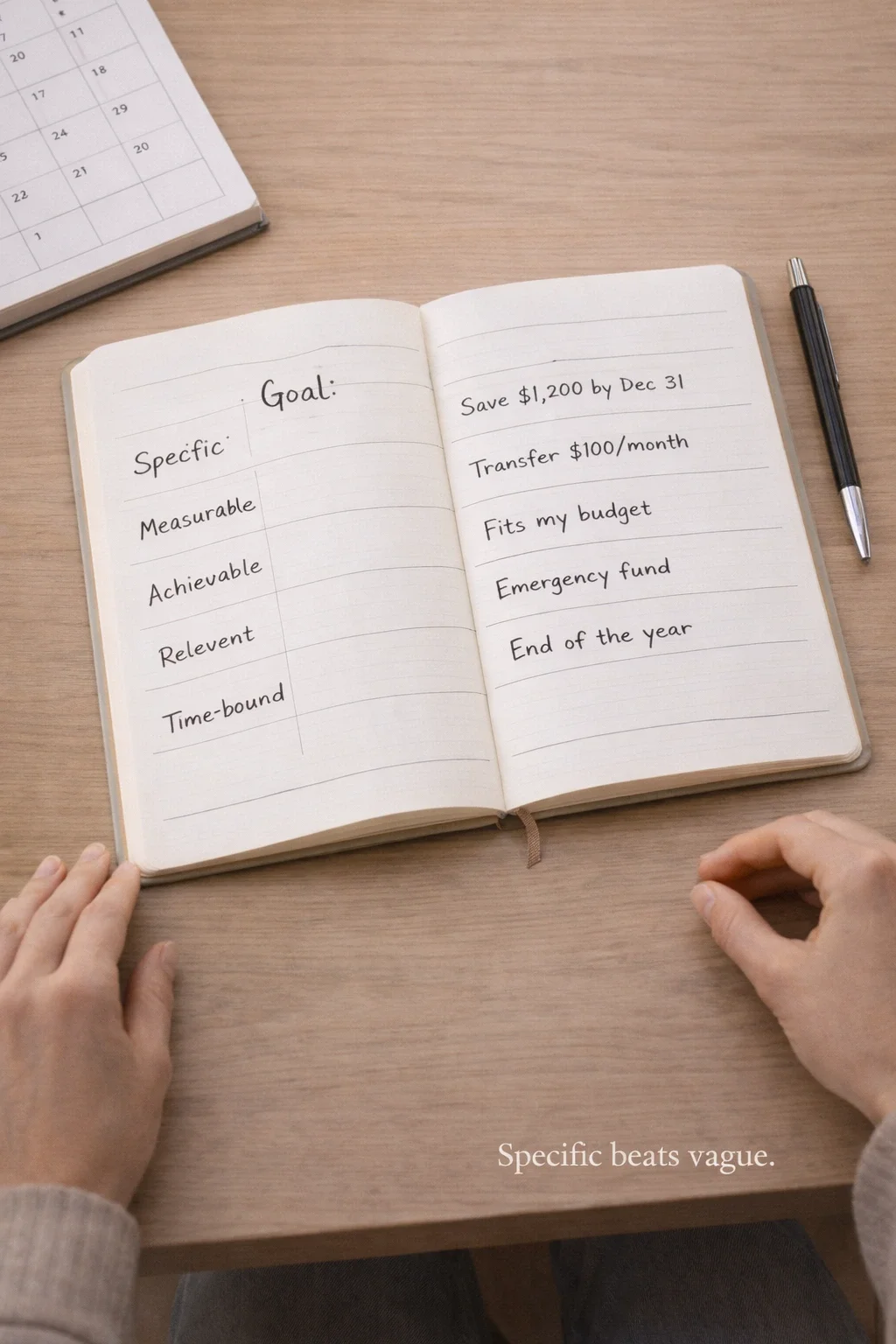
Vague goals are emotionally satisfying and operationally useless. They give you a temporary rush—then leave you with no clear next step when the day gets busy. SMART goals (Specific, Measurable, Achievable, Relevant, Time-bound) work because they move ambition out of the clouds and onto the calendar.
And if SMART goals still feel intimidating, Start With One offers the most practical entry point:
Start With One goal. One measurable step. One deadline.
Not to pressure yourself—just to give your life a compass you can actually use.
This guide gives you clear SMART goal examples across real life (health, money, career, relationships), plus quick answers to the common “People also ask” questions people search right alongside SMART goals.
What is SMART goal setting?
SMART goal setting is a method for writing goals in a way that makes action obvious.
A SMART goal is:
Specific: What exactly are you going to do?
Measurable: How will you track progress?
Achievable: Can it fit your current season of life?
Relevant: Does it match your values and priorities?
Time-bound: When will it be done?
Think of SMART as the difference between saying “I want to get fit” and saying “I will walk 30 minutes after dinner Monday–Friday for the next 8 weeks.”
One is a desire. The other is a plan.
What are the five SMART goals?
People often ask this phrasing, but it’s slightly misleading: SMART isn’t “five goals.” It’s five qualities that make any goal usable.
Still, if you want a simple way to remember it, here’s the “five SMARTs” checklist:
Specific outcome
Measurable metric
Achievable scope
Relevant reason
Time-bound deadline
If your goal fails one of these, it’s not “bad.” It just needs rewriting.
The Start With One upgrade to SMART goals
SMART goals get you clarity. Start With One gets you follow-through.
Here’s the twist many people miss: goals don’t fail because they weren’t SMART enough. They fail because they weren’t small enough to start.
So after you write a SMART goal, add a sixth line:
Start With One: What is the smallest action I can do today in 2–10 minutes?
That one action is how you cross the gap between planning and living.
How do I write a SMART goal?
Use this fill-in-the-blank template:
I will [SPECIFIC ACTION] by [MEASURABLE AMOUNT], by [DATE], by doing [REPEATABLE SYSTEM].
Example:
“I will save $1,200 by Dec 31 by transferring $100 each month automatically.”
Now, pressure-test it with two questions:
Could a stranger tell if I succeeded?
Can I do this on a hard week?
If the answer is no, shrink the scope until it becomes durable.
What are short SMART goals?
Short SMART goals are simply SMART goals with short time horizons—often 7, 14, or 30 days—designed to build momentum quickly.
They work because they create fast feedback:
You see progress
You correct course
You build trust in yourself
A short SMART goal is a confidence builder, not a life sentence.
Examples:
“For the next 14 days, I will read 10 pages before bed at least 10 nights.”
“For the next 7 days, I will track spending in my notes app daily.”
SMART goals examples you can copy (real life, not fantasy life)
Below are practical examples across common life areas. If you’re choosing just one, pick the one that reduces stress fastest—because less stress creates more capacity for everything else.
1) Career and professional growth
Example A — AI upskilling (2026-ready):
“I will complete an ‘AI for Professionals’ certification by June 30, 2026, by studying 3 hours per week and finishing one module every 10 days.”
Example B — networking with structure:
“I will add 10 new professional connections per month in 2026 by sending 3 thoughtful messages every week and attending 3 industry events this year.”
Example C — project efficiency:
“I will reduce project turnaround time by 15% by April 2026 by implementing one project management tool and running weekly 15-minute reviews.”
Start With One: block one 30-minute “learning sprint” this week.
2) Health and wellbeing
Example A — fitness with a finish line:
“I will run a half marathon by September 2026 by following a 16-week plan starting in May and completing 3 runs per week.”
Example B — mental health (simple, measurable):
“I will practice 10 minutes of mindfulness daily for the first 90 days of 2026 using a timer and tracking it in a habit app.”
Example C — screen time reduction:
“I will limit non-work screen time to 30 minutes/day for 30 days by setting app limits and keeping my phone out of the bedroom.”
Start With One: choose one “anchor habit” today (10-minute walk, 10-minute meditation, 10 minutes of prep).
3) Money and stability
Example A — emergency fund:
“I will build a $15,000 emergency fund by Dec 31, 2026 by automatically saving $1,250/month.”
Example B — expense reduction:
“I will reduce recurring monthly expenses by 10% by June 2026 by auditing subscriptions and negotiating one bill per month.”
Example C — debt payoff:
“I will pay off $2,500 of credit card debt by Aug 31 by paying $325 every payday and avoiding new balances.”
Start With One: automate one transfer—even $10—this payday.
4) Relationships and personal life
Example A — connection that’s actually scheduled:
“I will have one phone-free dinner per week for the next 8 weeks and ask one meaningful question at the table.”
Example B — friendship maintenance:
“I will reconnect with 4 friends in March by sending one message every Sunday and scheduling two meetups.”
Example C — family time boundaries:
“I will protect two evenings per week for family time for the next 30 days by declining non-essential commitments after 6 p.m.”
Start With One: send one message today. Not a perfect message. A real one.
5) Learning and personal growth
Example A — language goal:
“I will reach B1 Spanish by October 2026 by practicing 30 minutes/day and completing one weekly conversation session.”
Example B — reading habit with output:
“I will read 12 books in 2026 (1/month) and write a 10-line summary after each book.”
Example C — skill mastery:
“I will complete a 4-week data visualization course by March 31, 2026 by studying 4 sessions/week.”
Start With One: open the course, watch the first 5 minutes, stop. Momentum counts.
People Also Ask: Quick answers, clearly explained
What are the SMART goals examples?
SMART goal examples are goals written with clear action, measurement, and deadlines—like:
“Save $1,200 by Dec 31 via $100 monthly auto-transfers”
“Walk 30 minutes 5 days/week for 8 weeks”
“Publish 2 videos/week for 90 days”
The best examples include a built-in system, not just an outcome.
What is SMART goal setting?
It’s the practice of turning vague intentions into clear plans by making goals Specific, Measurable, Achievable, Relevant, and Time-bound.
What are the five SMART goals?
SMART isn’t five goals; it’s five criteria. Use the SMART checklist to upgrade any goal.
How do I write a SMART goal?
Use this template:
“I will [ACTION] by [MEASURE] by [DATE] by doing [SYSTEM].”
What are the 10 examples of goals?
Here are 10 SMART-style goals (copy/paste-friendly):
Save $500 by May 31 via $25 weekly transfers
Track spending daily for 14 days
Walk 20 minutes after dinner 4x/week for 6 weeks
Sleep by 11 p.m. at least 5 nights/week for 30 days
Cancel 2 subscriptions by Friday and redirect savings
Cook at home 4 nights/week for 1 month
Read 10 pages nightly for 21 days
Apply to 15 jobs by the end of the month
Publish 1 LinkedIn post/week for 8 weeks
Do 12 strength workouts in 6 weeks
What are short SMART goals?
Short SMART goals run 7–30 days. They’re designed for quick wins and rapid adjustment—perfect for building momentum.
Actionable takeaways you can use today
The 10-minute SMART rewrite
Write one goal you’ve been carrying around in your head
Add a number (measure)
Add a date (deadline)
Add a repeatable system (weekly/daily action)
Add a 2-minute “Start With One” action for today
The “One More Goal” rule
If you’re overwhelmed, don’t set five goals. Set one goal that reduces stress and increases stability first. The calmer you are, the better you plan.
Conclusion: A goal is not a wish—it’s a direction you can return to
SMART goals aren’t about being intense. They’re about being honest. Honest about time. Honest about energy. Honest about what you’re willing to repeat.
And if you’ve been stuck—planning, revising, restarting—try the simplest thing that works:
Start With One goal.
One number. One deadline. One small daily action.
Then let consistency do what motivation never could.
📘 Get the book: Start With One: Small Steps to a Big Change → a.co/d/5uoSTEJ

🔗 The “SMART Goal Toolkit” Source Shelf — Credible Links Behind the Blog
Asana — SMART goals framework + examples:
https://asana.com/resources/smart-goalsPeoplebox — Leadership SMART goals examples (2026):
https://www.peoplebox.ai/blog/leadership-smart-goals-examples-2026/Shopify — Sales goals guidance + examples:
https://www.shopify.com/in/blog/sales-goalsUniversity of Rhode Island (URI) SBDC — Setting SMART goals for 2026 (small business guide):
https://web.uri.edu/risbdc/setting-smart-goals-for-2026-a-practical-guide-for-small-business-owners/