What Does Don’t Fit In Mean?

What Does “Don’t Fit In” Mean?
Don’t Fit In: Forge Your Own Path
“Don’t fit in” means you do not feel fully accepted, understood, or comfortable within a particular group, culture, environment, or social situation. It can happen when your personality, values, interests, appearance, communication style, or life choices do not match what others seem to expect.
Not fitting in can feel lonely.
You may be included but not known.
Present but not relaxed.
Accepted only when you edit yourself.
Surrounded by people, yet still aware that something about you feels different.
But not fitting in does not automatically mean something is wrong with you.
Sometimes it means you are in the wrong room. Sometimes it means you are still learning how to express yourself. Sometimes it means your values are asking for a life that looks different from the one around you.
The Start With One philosophy offers a grounded way forward:
Do not abandon yourself to gain approval.
Do not isolate yourself to protect your difference.
Begin with one honest choice.
Don’t fit in. Forge your own path.
What Does It Mean If You Don’t Fit In?
If you do not fit in, it usually means there is a gap between who you naturally are and what a group rewards or expects.
That gap might involve:
Your values
Your personality
Your interests
Your beliefs
Your goals
Your humour
Your pace of life
Your appearance
Your communication style
Your need for quiet, depth, creativity, or independence
In some situations, fitting in simply means adapting to a shared environment. We all adjust in healthy ways: listening, respecting norms, showing consideration, and learning how to cooperate.
But unhealthy fitting in asks for more than respect.
It asks you to shrink.
You laugh when you do not mean it.
You agree when something inside you hesitates.
You hide your ambition.
You soften your opinions until they no longer sound like yours.
You perform a version of yourself that keeps everyone comfortable except you.
That is where the cost begins.
What Is It Called When You Don’t Fit In?
A person who does not fit in may be called an outsider, nonconformist, misfit, individualist, or outlier.
Some of these words can sound negative, but they do not have to be.
An outsider may see what insiders overlook.
A nonconformist may question rules others follow automatically.
A misfit may simply be someone who has not yet found the right environment.
An outlier may become a creator, builder, leader, artist, reformer, or original thinker.
The label matters less than the direction it gives you.
If “I don’t fit in” becomes “I am broken,” it can lead to shame.
If it becomes “I need to understand where I truly belong,” it can become the beginning of growth.
Fitting In Is Not the Same as Belonging
This distinction is essential.
Fitting in means changing yourself to be accepted.
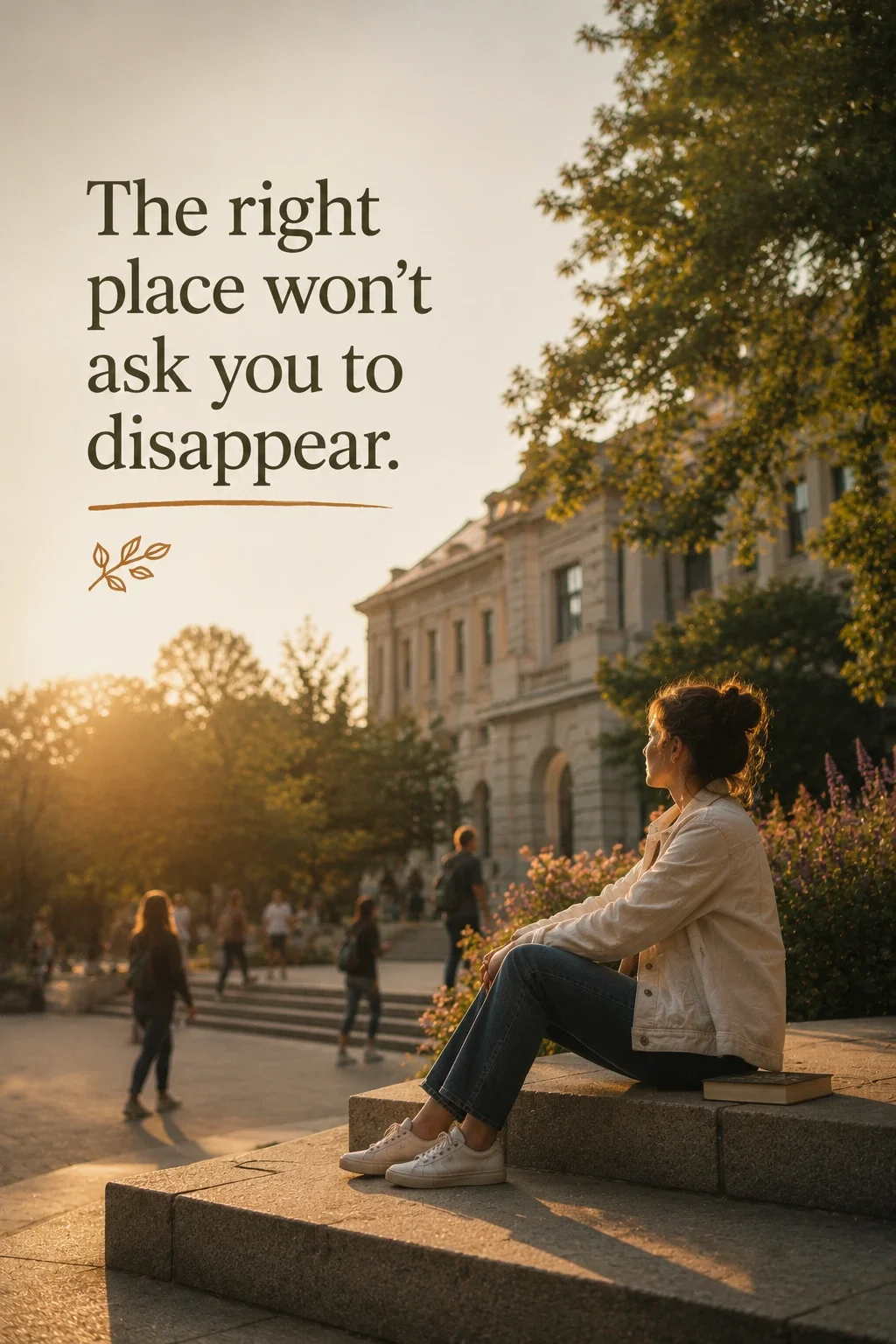
Belonging means being accepted without having to disappear.
Fitting in asks:
Who do I need to become so they will approve of me?
Belonging asks:
Where can I be honest and still be welcomed?
Many people confuse inclusion with belonging. You can be invited to the table and still feel unseen. You can be part of a group and still feel like you are acting. You can receive approval and still feel lonely because the approval is going to the version of you that is performing.
Belonging is different.
It does not mean everyone understands every part of you. It means you are not required to betray yourself in order to stay connected.
When Someone Says They Don’t Fit In
When someone says they do not fit in, they may be saying more than the words themselves.
They may mean:
“I feel different.”
“I feel judged.”
“I feel lonely.”
“I do not know where I belong.”
“I am tired of pretending.”
“I am afraid the real me will not be accepted.”
“I want connection, but not at the cost of myself.”
This is why the phrase deserves compassion.
Not fitting in can be painful because human beings are wired for connection. We need relationships, recognition, and social safety. But connection built on self-erasure is not true safety.
The better question is not always, “How do I fit in?”
Sometimes the better question is:
“Where do I feel free to be honest?”
Do People With ADHD Feel Like They Don’t Fit In?
Some people with ADHD may feel like they do not fit in, especially if their attention, energy, emotional intensity, impulsivity, communication style, or executive-function challenges are misunderstood.
They may have heard comments such as:
“You talk too much.”
“You are too sensitive.”
“Why can’t you just focus?”
“You are disorganized.”
“You are not trying hard enough.”
Over time, those messages can create a sense of being different or out of step with others.
But ADHD is not a character flaw. It is a neurodevelopmental condition that affects attention, regulation, planning, memory, and impulse control. The goal is not for someone with ADHD to erase who they are. The goal is to build support, strategies, self-understanding, and environments where they can function and belong more fully.
If feelings of not fitting in are connected to ADHD, anxiety, depression, bullying, trauma, or persistent loneliness, professional support can help. You do not have to turn difference into isolation.
Why Not Fitting In Can Hurt
Not fitting in hurts because it touches one of the deepest human needs: the need to belong.
Exclusion, rejection, or constant self-editing can affect confidence, mood, motivation, and identity. It can make ordinary situations feel like performances. It can make people second-guess their voice, style, interests, dreams, or boundaries.
The pain is real.
But the conclusion we draw from that pain matters.
Pain says: “I need connection.”
Shame says: “I am the problem.”
Wisdom asks: “What kind of connection allows me to remain whole?”
Not every room is your room.
That is not failure.
That is information.
The Modern Pressure to Fit In
Today, fitting in is no longer limited to school, work, family, or social circles.
It also happens online.
Algorithms reward patterns. Trends move quickly. People are encouraged to package their identity, monetize their hobbies, document their lives, and make even rest look impressive.
The modern pressure says:
Be authentic, but make it attractive.
Be different, but not confusing.
Be successful, but effortless.
Be vulnerable, but not uncomfortable.
Be yourself, but in a way that performs well.
That is exhausting.
Forging your own path may now mean keeping parts of your life private. Choosing depth over reach. Protecting hobbies that do not become side hustles. Building real-world relationships. Caring openly in a culture that often rewards detachment.
Sometimes the most original thing you can do is stop performing.

How to Stop Trying to Fit In
You do not have to change everything at once.
Start With One honest step.
1. Name Where You Are Performing
Ask yourself:
Where do I feel most edited?
Who am I trying to impress?
What do I pretend not to care about?
What part of me do I keep hiding?
Awareness is the first act of freedom.
2. Define Your Non-Negotiables
Choose the values you do not want to trade for approval.
They may include honesty, creativity, family, health, faith, independence, kindness, sobriety, quiet, ambition, or meaningful work.
Non-negotiables help you stop confusing acceptance with alignment.
3. Find Better Rooms
Sometimes you do not need a new personality.
You need different people.
Look for spaces where your interests, values, pace, or questions are more welcome. That may mean a creative group, recovery community, faith community, professional circle, volunteer space, local club, or one honest friendship.
Belonging often begins smaller than we expect.
4. Keep Something Private
Not everything has to be posted, explained, optimized, or approved.
Keep one joy for yourself.
A walk.
A notebook.
A hobby.
A dream.
A quiet routine.
A friendship that does not need an audience.
Private life is not wasted life.
5. Practise Honest Expression
Say one true thing kindly.
That may sound like:
“I actually see it differently.”
“I need time to think.”
“That does not feel right for me.”
“I care about this.”
“I am not available for that.”
“This matters to me.”
You do not need to shock people.
You only need to stop disappearing.
How Can I Forge My Own Path?
Forging your own path does not mean rejecting everyone else.
It means choosing your direction consciously.
A strong path is built from:
Values
Curiosity
Courage
Discipline
Relationships
Boundaries
Self-respect
Small consistent choices
The immature version of individuality says, “I am different, so I do not need anyone.”
The mature version says, “I know who I am, so I can connect without disappearing.”
That is the balance.
Be open enough to grow.
Be grounded enough not to be shaped by every room you enter.
A Start With One Exercise
Choose one action this week:
Say one honest sentence.
Decline one thing that does not align.
Spend time with one person who makes honesty easier.
Keep one experience offline.
Revisit one dream you have been hiding.
Leave one room, habit, or conversation that requires too much self-abandonment.
Enter one better room.
Small acts of authenticity create evidence.
Evidence builds confidence.
Confidence becomes direction.
Frequently Asked Questions
What does “don’t fit in” mean?
It means you do not feel fully accepted, comfortable, or aligned with a particular group or environment. Your values, personality, interests, appearance, or way of living may not match the expectations around you.
What does it mean if you don’t fit in?
It may mean you are in the wrong environment, hiding parts of yourself, still developing social confidence, or looking for people who better match your values. It does not automatically mean something is wrong with you.
What is it called when you don’t fit in?
Common words include outsider, misfit, nonconformist, individualist, or outlier. These words can feel negative, but they can also point to originality, independence, and a different way of seeing the world.
Do people with ADHD feel like they don’t fit in?
Some people with ADHD do feel this way, especially when their attention, energy, emotions, or communication style are misunderstood. ADHD is not a flaw. Support, self-understanding, and the right environment can make belonging easier.
When someone says they don’t fit in, what might they mean?
They may be expressing loneliness, discomfort, self-doubt, exhaustion from pretending, or a desire to find people who accept them more honestly.
What does the idiom “don’t fit in” mean?
The idiom means someone does not seem to belong naturally in a group, place, or situation because they are different in behaviour, values, style, personality, or expectations.
You Were Not Made for Every Room
There will be rooms where you feel too quiet.
Rooms where you feel too intense.
Rooms where your questions are inconvenient.
Your dreams seem unrealistic.
Your values seem unusual.
Your honesty feels disruptive.
Do not confuse those rooms with the whole world.
You are allowed to adapt.
You are allowed to learn.
You are allowed to grow.
But you are not required to abandon yourself to be accepted.
Start With One honest choice.
One value protected.
One private joy reclaimed.
One better room entered.
One sentence that sounds like you.
One step that feels like your own.
You may not fit in everywhere.
That was never the goal.
Don’t fit in. Forge your own path.
📘 Get the book: Start With One: Small Steps to a Big Change → a.co/d/5uoSTEJ
Forge Your Own Path: Sources Behind “What Does ‘Don’t Fit In’ Mean?”
Cambridge Dictionary — Meaning of “Fit In”
https://dictionary.cambridge.org/dictionary/english/fit-inPsychology Today — Stop Trying to Fit In, Aim to Belong Instead
https://www.psychologytoday.com/us/blog/prescriptions-for-life/201310/stop-trying-to-fit-in-aim-to-belong-insteadCDC — Social Connection, Loneliness and Isolation Risk Factors
https://www.cdc.gov/social-connectedness/risk-factors/index.htmlNational Library of Medicine / PMC — Social Media Use, Self-Presentation and Social Comparison
https://pmc.ncbi.nlm.nih.gov/articles/PMC9518022/National Library of Medicine / PMC — Social Connection, Loneliness and Health
https://pmc.ncbi.nlm.nih.gov/articles/PMC11403199/GoodRx — Why You Might Feel Like You Don’t Fit In Anywhere
https://www.goodrx.com/health-topic/mental-health/i-dont-fit-in-anywhereSucceed Socially — Why You Might Not Fit Into Any Social Group
https://www.succeedsocially.com/dontfitintoanygroupSucceed Socially — Fitting In Socially
https://www.succeedsocially.com/fittinginIntrovert, Dear — Survival Tips for When You Don’t Fit In With a Social Group
https://introvertdear.com/news/survival-tips-for-when-you-dont-fit-in-with-a-social-group/Get Inflow — Managing FOMO, Anxiety, Depression and ADHD
https://www.getinflow.io/post/manage-fomo-anxiety-depression-adhdMedium — Fitting In vs. Belonging
https://medium.com/@lalita.nordquist/fitting-in-vs-belonging-ecb8e8489b81Start With One — Source Book Inspiration
Start With One: Small Steps to a Big Change
Relevant theme: “Don’t Fit In: Forge Your Own Path”