What Is Cold Therapy Good For?
One Cold Shower: Embracing Discomfort for Vitality and Growth
Cold therapy is good for short-term muscle recovery, reducing soreness and swelling, improving alertness, supporting mood, and practicing stress resilience. It may help some people feel calmer, sharper, and more energized, but it is not a cure-all, and it is not safe for everyone. People with heart disease, high blood pressure, circulation issues, nerve problems, diabetes, or who are at risk during pregnancy should speak with a healthcare professional before trying cold plunges or intense cold exposure. Cleveland Clinic warns that cold water can raise blood pressure, make the heart work harder, and trigger rapid breathing or dizziness in some people. (Cleveland Clinic)
There is a particular honesty in cold water.
It does not negotiate. It does not flatter. It does not care how motivated you feel. The moment cold water hits your skin, your body tells the truth: your breath shortens, your shoulders tighten, your mind protests, and every instinct says, get out.
Then something important happens.
You breathe.
You stay for one more second. Then another. The shock becomes sensation. The panic becomes focus. The discomfort becomes a teacher.
That is why cold therapy has become one of the most talked-about wellness practices of modern life. Cold showers, ice baths, cold plunges, winter swimming, and cryotherapy are now used by athletes, entrepreneurs, wellness seekers, and everyday people looking for recovery, energy, discipline, and a clearer mind.
But the truth is colder and more useful than the hype.
Cold therapy can be helpful. It can reduce exercise soreness, support recovery, sharpen alertness, and help train your stress response. It can also be risky when done too intensely, too long, or by people with underlying health conditions. The best approach is not extreme. It is intentional.
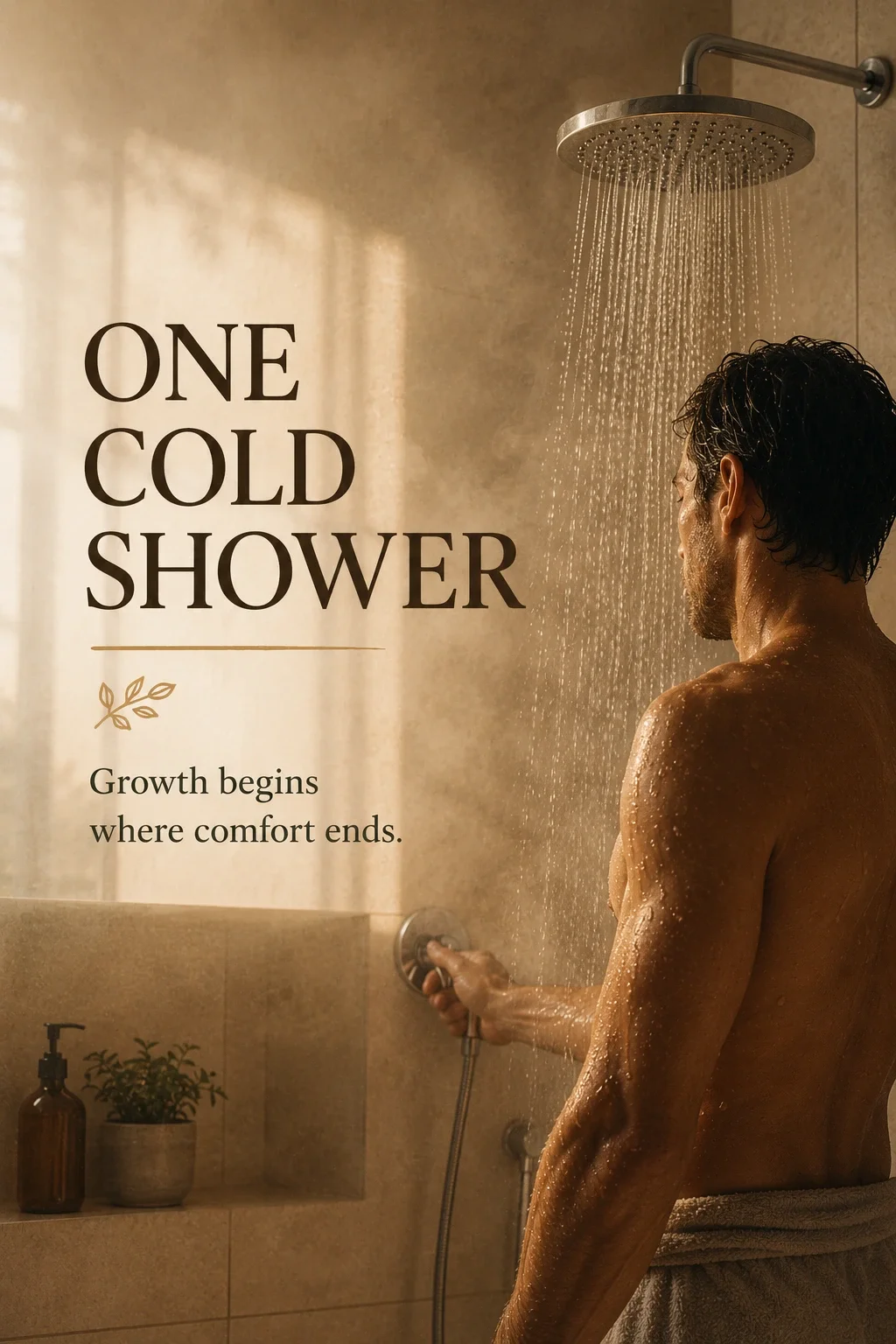
In the Start With One philosophy, the chapter “One Cold Shower” frames cold exposure as a small act of voluntary discomfort: a practice in breathing, choice, resilience, and growth.
You do not need to become extreme.
You can begin with one breath.
One calm response.
One short cold finish to a warm shower.
One small moment where you choose steadiness over panic.
Start With One cold shower.
What Is Cold Therapy?
Cold therapy is the intentional use of cold temperatures to create a physical or mental response. Common forms include:
Cold showers
Cold plunges
Ice baths
Cold-water immersion
Winter swimming
Cryotherapy chambers
Ice packs for injuries
Contrast therapy, alternating heat and cold
The most accessible form is a cold shower. The most common intense form is cold-water immersion, where the body is submerged in cold water for a short time.
Mayo Clinic Health System notes that cold plunging may reduce inflammation and soreness after exercise, while also potentially supporting resilience, nervous-system balance, cognitive function, and mood. (Mayo Clinic Health System)
The keyword is intentional.
Cold therapy is not simply being cold. It is choosing a controlled dose of cold exposure for a clear purpose: recovery, alertness, mood, stress training, pain relief, or resilience.
What Is Cold Therapy Good For?
Cold therapy is mainly good for five things:
First, it may reduce muscle soreness after intense exercise. A 2023 review found that cold-water immersion after exercise can reduce delayed-onset muscle soreness and accelerate fatigue recovery. (PMC)
Second, it can provide short-term pain relief by numbing sore or irritated areas. Mayo Clinic Press notes that localized cold can still be useful for sore muscles or swollen joints, even while broader cryotherapy claims remain uncertain. (Mayo Clinic Press)
Third, it can increase alertness because cold exposure activates the nervous system and creates an immediate wake-up response. Mayo Clinic Health System says cold plunging may help cognitive function and mood. (Mayo Clinic Health System)
Fourth, it may help some people manage stress. Harvard Health reported that ice baths were associated with lower stress levels after immersion in recent research, though effects varied and were not universal. (Harvard Health)
Fifth, it can become a mental resilience practice. Cold water creates discomfort on purpose, giving you a safe opportunity to practice breathing, staying calm, and responding instead of reacting.
That final benefit may be the most valuable one for personal growth.
Cold therapy teaches a skill that carries into life: when discomfort arrives, pause before you panic.
Why Is Ice No Longer Recommended for Every Injury?
Ice is not “bad,” but it is no longer automatically recommended for every injury in the old-fashioned way many people learned.
For years, people were told to use RICE: rest, ice, compression, elevation. Today, many clinicians take a more nuanced view. Ice can help reduce pain and swelling in the short term, but too much icing may not always support the full healing process, especially if it delays movement, circulation, or appropriate rehabilitation.
The better question is not, “Is ice good or bad?”
The better question is, “What is the goal?”
For a swollen ankle or sore joint, a short period of cold may help with pain and swelling. For long-term recovery, movement, strength, circulation, sleep, and medical guidance often matter more. Mayo Clinic Press says localized cold can help sore muscles or swollen joints, but it also cautions that some larger cryotherapy claims remain uncertain. (Mayo Clinic Press)
So ice is still useful. It is just not the whole recovery plan.
Cold can calm pain.
Movement restores function.
Rest repairs tissue.
Strength protects the future.
How Does Cold Therapy Help Muscle Recovery?
Cold exposure causes blood vessels to narrow. This may reduce swelling and inflammation after intense exercise. When the body warms again, blood flow changes, which may help people feel refreshed and less sore.
This is why athletes often use cold-water immersion after hard workouts, games, races, or long endurance sessions. Mayo Clinic Health System reports that icy water may help recovery after exercise by reducing inflammation and soreness. (Mayo Clinic Health System)
A 2025 analysis found that different cold-water immersion doses produced different recovery effects, with certain 10-to-15-minute protocols helping soreness or recovery markers depending on water temperature. (PubMed)
But timing matters.
If your main goal is muscle growth, do not rush into a cold plunge immediately after heavy strength training. Cold exposure may reduce some of the inflammation and cellular signaling involved in muscle adaptation. This does not mean cold therapy ruins progress. It means the timing should match the goal.
For soreness after endurance work, cold may help.
For mental alertness, a morning cold shower may help.
For maximum muscle growth, separate cold plunges from heavy lifting.
How to Do Cold Therapy at Home
The safest and simplest way to start cold therapy at home is with a short cold finish at the end of a warm shower.
Do not begin with an extreme ice bath. Do not try to prove toughness. Do not hold your breath. Do not chase pain.
Try this beginner-friendly approach:
Week 1: 15 Seconds Cool
At the end of your normal shower, turn the water cool for 15 seconds. Breathe slowly. Let your shoulders drop. Your goal is not endurance. Your goal is calm.
Week 2: 30 Seconds Colder
Make the water slightly colder. Keep your breathing steady. Notice the urge to tense up, then soften one part of your body.
Week 3: 60 Seconds Cold
Stay only as long as you feel safe and in control. The first victory is not staying in longer. The first victory is staying calm.
Week 4: Choose Your Purpose
Ask yourself: why am I doing this?
Recovery?
Energy?
Mood?
Discipline?
Stress tolerance?
Curiosity?
Your goal should guide your practice.
WebMD warns that entering cold water too quickly can shock the body and affect breathing, heart rate, blood pressure, or mental state, and that staying too long can increase the risk of hypothermia or numbness. (WebMD)
Start small. Stay aware. Build gradually.
How Long Should You Perform Cold Therapy?
For beginners, cold showers can start with 15 to 60 seconds.
For cold plunges, many beginner protocols use 1 to 3 minutes in moderately cold water, gradually increasing only if the person is healthy, adapted, and comfortable. More is not always better.
Harvard Health warns that sudden submersion in very cold water can shock the body, causing rapid breathing, involuntary gasping, and spikes in heart rate and blood pressure, and says ice baths should not be done without someone nearby. (Harvard Health)
A safe general principle is this:
Cold therapy should feel challenging, not dangerous.
You should be able to breathe.
You should be able to think clearly.
You should be able to exit safely.
You should warm up naturally afterward.
You should not feel numb, confused, faint, or panicked.
For most people, the goal is not a long battle with the cold. The goal is a brief, controlled exposure that supports recovery or resilience.
What Is the Best Cold Therapy?
The best cold therapy depends on your goal.
Best for Beginners: Cold Showers
Cold showers are accessible, inexpensive, easy to control, and lower risk than plunging into very cold water.
Best for Local Pain or Swelling: Ice Packs
For a sore joint, sprain, or localized swelling, a simple ice pack may be more appropriate than full-body cold exposure.
Best for Post-Workout Soreness: Cold-Water Immersion
Cold plunges or ice baths may help after intense endurance training, long runs, games, or competitions. Research supports cold-water immersion for reducing soreness and improving perceived recovery after exercise. (PMC)
Best for Mental Alertness: Morning Cold Shower
A short cold shower in the morning can create a quick sense of wakefulness and focus.
Best for Stress Training: Short Controlled Exposure
The best stress-resilience practice is not the coldest water. It is the exposure you can meet with calm breathing.
The best cold therapy is the one that is safe, purposeful, repeatable, and matched to your health and goals.
How Many Minutes a Week Should You Cold Plunge?
There is no universal number of minutes per week that works for everyone.
A cautious beginner might start with 2 to 5 total minutes per week, using short exposures. More experienced people may build gradually, but more exposure does not automatically mean better results.
For many people, consistency matters more than duration.
A few short cold showers each week may be enough to build the habit of calm under pressure. Athletes using cold-water immersion for recovery may use it after specific hard sessions rather than every day.
Harvard Health says the evidence for many cold-plunge benefits remains limited and that cold plunges may be risky for people with underlying heart problems. (Harvard Health)
So the smarter question is not, “How many minutes can I tolerate?”
It is:
What am I trying to improve?
How does my body respond?
Am I safe?
Is this helping my recovery, mood, or resilience?
Or am I just chasing intensity?
Cold therapy should serve your life, not become another pressure to perform.
Mental Benefits: Why Cold Water Feels So Powerful
Cold water gets your attention instantly.
That is part of the appeal. In a distracted world, cold exposure forces you into the present moment. You cannot scroll, multitask, worry about tomorrow, and fully experience cold water at the same time. The body demands presence.
Many people report feeling alert, calm, energized, or emotionally reset afterward. Harvard Health summarized recent research showing that ice baths reduced stress levels after immersion and that cold-shower participants reported higher quality-of-life scores compared with regular-shower participants, though results varied. (Harvard Health)
This is important: cold therapy may help some people feel better, but it should not be treated as a replacement for therapy, medication, sleep, community, nutrition, exercise, or medical care.
Cold water can reset a moment.
It cannot carry an entire mental-health plan by itself.
Cardiovascular and Metabolic Effects: Promise and Caution
Cold exposure affects circulation because blood vessels constrict in response to cold. The body then works to maintain core temperature. Some researchers are studying the effect of cold exposure on brown fat, metabolism, insulin sensitivity, and cardiovascular health.
But this is where the conversation must stay honest.
The fact that cold exposure causes a strong physical response does not mean it is automatically beneficial for everyone. Cleveland Clinic says cold water constriction raises blood pressure and forces the heart to work harder, which can be dangerous for people with heart conditions, hypertension, or elevated stroke risk. (Cleveland Clinic)
The American Heart Association also warns that sudden cold-water immersion can trigger rapid increases in breathing, heart rate, and blood pressure, known as the cold shock response. (www.heart.org)
For healthy people, brief cold exposure may feel invigorating.
For vulnerable people, it may be risky.
The same stimulus can be useful or dangerous depending on the body receiving it.
Who Should Avoid Cold Therapy or Ask a Doctor First?
Speak with a healthcare professional before trying cold plunges, ice baths, winter swimming, or intense cold exposure if you have:
Heart disease
High blood pressure
History of stroke
Irregular heartbeat
Poor circulation
Diabetes
Nerve damage or neuropathy
Raynaud’s disease
Fainting episodes
Seizure history
Pregnancy
Respiratory disease
Any major medical condition
Cold exposure is also not recommended when you are intoxicated, alone in open water, exhausted, unable to exit safely, or trying to impress others.
Cold therapy is not a bravery contest.
It is a controlled practice.
Cold Therapy Safety Rules
Start with cold showers before ice baths.
Keep early sessions short.
Never hold your breath.
Never cold plunge alone in unsafe settings.
Do not submerge your head as a beginner.
Exit if you feel dizzy, numb, confused, panicked, or faint.
Warm up gradually afterward.
Avoid intense cold exposure after alcohol or recreational drugs.
Do not use cold therapy as punishment.
Ask a clinician first if you have medical risk factors.
The goal is adaptation, not danger.
The Start With One Cold Shower Practice
Here is a simple Start With One framework:
Step 1: Begin warm.
Take your normal shower.
Step 2: Turn the water cool.
Not freezing. Just uncomfortable enough to notice.
Step 3: Breathe slowly.
Let the exhale become longer than the inhale.
Step 4: Relax one thing.
Your jaw. Your shoulders. Your hands. Your stomach.
Step 5: Stay for one calm moment.
Not as long as possible. Just long enough to choose your response.
Step 6: End with respect.
Warm up. Notice how you feel. Do not turn it into ego.
This is where cold therapy becomes more than wellness.
It becomes practice.
Practice for hard conversations.
Practice for uncertainty.
Practice for stress.
Practice for the moment between reaction and choice.
What Cold Therapy Is Not
Cold therapy is not a miracle cure.
It is not guaranteed to cause fat loss.
It is not a replacement for sleep.
It is not a substitute for medical treatment.
It is not always best after strength training.
It is not safe for everyone.
It is not better just because it is colder or longer.
Cold therapy is one tool.
The foundation remains the same: sleep, movement, nutrition, relationships, stress management, purpose, and appropriate medical care.
Used wisely, cold therapy can support the system.
It should not replace the system.
FAQ: Cold Therapy Questions People Also Ask
What is cold therapy good for?
Cold therapy is good for reducing short-term muscle soreness, supporting post-workout recovery, easing localized pain or swelling, increasing alertness, and practicing stress resilience. It may also improve mood for some people, but evidence varies, and it should not replace medical or mental-health care. (Mayo Clinic Health System)
Why is ice no longer recommended?
Ice is still useful for short-term pain and swelling, but it is no longer seen as the only answer for every injury. Recovery often also requires movement, circulation, strength, sleep, and proper rehabilitation. Localized cold can help sore muscles or swollen joints, but broader claims should be treated carefully. (Mayo Clinic Press)
How do you do cold therapy at home?
Start with a normal warm shower, then finish with 15 to 30 seconds of cool water. Breathe slowly and stay relaxed. Over several weeks, gradually build toward 60 seconds if it feels safe. Avoid extreme temperatures at first.
How long should cold therapy last?
Beginners can start with 15 to 60 seconds in a cold shower. Cold plunges often begin around 1 to 3 minutes, depending on water temperature, health status, and experience. Longer sessions increase risk and are not automatically better. Harvard Health warns that very cold water can cause rapid breathing, gasping, and spikes in heart rate and blood pressure. (Harvard Health)
What is the best cold therapy?
The best cold therapy depends on the goal. Cold showers are best for beginners and alertness. Ice packs are best for localized pain or swelling. Cold-water immersion may help athletes reduce soreness after intense exercise. The best method is safe, controlled, and matched to your purpose.
How many minutes a week should you cold plunge?
There is no universal weekly target. Beginners may start with 2 to 5 total minutes per week across short sessions. Athletes may use cold plunges after specific hard workouts. More minutes are not always better, especially for people with heart, blood-pressure, or circulation risks.
Final Takeaway: The Cold Is Not the Point
Cold therapy is good for recovery, soreness, alertness, and resilience. It may support mood and stress management for some people. It may help athletes feel ready sooner after intense training. It may teach the body and mind to stay calm under pressure.
But the cold itself is not the point.
The point is the moment you choose your response.
You step in.
The body protests.
The mind wants out.
You breathe.
You soften.
You stay calm for one more second.
That is the deeper lesson.
Discomfort does not have to control you.
Intensity does not have to become panic.
Growth does not have to begin with something dramatic.
It can begin at the end of an ordinary shower.
One breath.
One choice.
One small act of courage.
Start With One cold shower.
📘 Get the book: Start With One: Small Steps to a Big Change → a.co/d/5uoSTEJ
Cold Water, Clear Mind: Source Links Behind “What Is Cold Therapy Good For?”
Cleveland Clinic — What to Know About Cold Plunges
https://health.clevelandclinic.org/what-to-know-about-cold-plungesMayo Clinic Health System — Cold Plunge After Workouts
https://www.mayoclinichealthsystem.org/hometown-health/speaking-of-health/cold-plunge-after-workoutsNational Library of Medicine / PMC — Cold-Water Immersion, Muscle Soreness and Recovery
https://pmc.ncbi.nlm.nih.gov/articles/PMC9896520/Mayo Clinic Press — Health Benefits and Risks of Cryotherapy
https://mcpress.mayoclinic.org/living-well/the-chilling-truth-exploring-the-health-benefits-and-risks-of-cryotherapy/Harvard Health — Can Ice Baths Improve Your Health?
https://www.health.harvard.edu/healthy-aging-and-longevity/can-ice-baths-improve-your-healthHarvard Health — Research Highlights Health Benefits From Cold Water Immersions
https://www.health.harvard.edu/healthy-aging-and-longevity/research-highlights-health-benefits-from-cold-water-immersionsHarvard Health — Cold Plunges: Healthy or Harmful for Your Heart?
https://www.health.harvard.edu/heart-health/cold-plunges-healthy-or-harmful-for-your-heartAmerican Heart Association — Cold Water Plunge Risks
https://www.heart.org/en/news/2022/12/09/youre-not-a-polar-bear-the-plunge-into-cold-water-comes-with-risksWebMD — Cold Plunge: Benefits and Safety
https://www.webmd.com/a-to-z-guides/cold-plungePubMed — Cold-Water Immersion Dose and Recovery Effects
https://pubmed.ncbi.nlm.nih.gov/40078372/National Library of Medicine / PMC — Cold-Water Immersion and Resistance Training Adaptation
https://pmc.ncbi.nlm.nih.gov/articles/PMC11235606/National Library of Medicine / PMC — Cold-Water Immersion After Resistance Exercise
https://pmc.ncbi.nlm.nih.gov/articles/PMC5285720/Start With One — Source Book Inspiration
Start With One: Small Steps to a Big Change
Relevant theme: “One Cold Shower: Embracing Discomfort for Vitality and Growth.”