What Is the Best Way to Actually Learn a New Language?

What Is the Best Way to Actually Learn a New Language?
One New Word: Weaving the Tapestry of Communication
Most people don’t “fail” at language learning because they’re incapable. They fail the way busy people fail at most good things: they start with intensity, collect too many resources, and then disappear for two weeks. When they return, they feel behind, and the cycle resets.
The best way to actually learn a language isn’t a single app or a heroic immersion fantasy. It’s a balanced system you can live with—one that combines daily contact, spaced repetition, and real communication. In other words: fewer grand promises, more small commitments.
That’s the Start With One philosophy in a new accent:
Start With One word today. One short session tomorrow. One real conversation this week.
Then repeat until the language stops feeling foreign and starts feeling familiar.
The best way to learn: a simple formula that doesn’t break
A practical, research-aligned approach looks like this:
1) Comprehensible input (the “I can mostly follow this” zone)
Your brain acquires language fastest when you’re exposed to content you understand most of—while still needing to stretch a little. Think easy YouTube, graded readers, beginner podcasts, slow news, simple stories. (Talkio)
Start With One: choose one content source you genuinely enjoy (a channel, a podcast, a short story series). Consistency beats variety.
2) Spaced repetition (SRS) instead of cramming
Cramming creates short-term familiarity; spaced retrieval creates long-term memory. Using an SRS tool (like Anki) with words in sentences helps you remember what words mean and how they behave. (Talkio)
Start With One: 10 minutes of SRS daily.
3) Real output (speaking/writing) with feedback
If you only consume, you’ll understand more than you can say—and you’ll stay “silent” longer than necessary. Speaking and writing reveal gaps and accelerate learning when you get gentle feedback.
Start With One: one 20–30 minute conversation per week (tutor or language exchange).
The routine that works when motivation doesn’t
Here’s a simple weekly structure you can actually sustain:
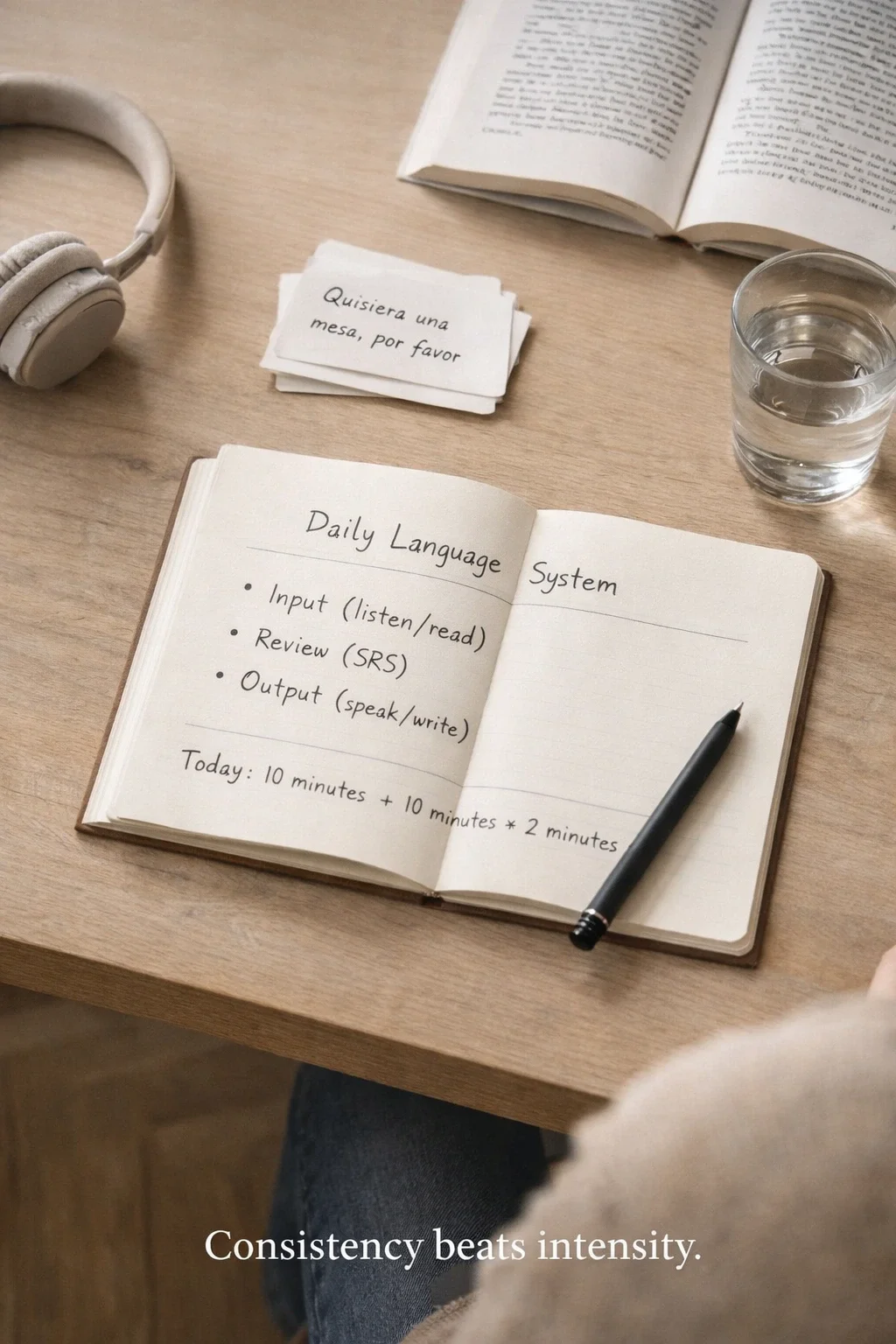
Daily (20–40 minutes)
10–20 minutes: easy listening/reading (comprehensible input)
10–15 minutes: SRS review (vocab in context)
2–5 minutes: one tiny “output” moment (a sentence journal, a voice note, a text)
Weekly (2–4 times)
1–2 short conversation sessions (30–60 minutes)
1 short writing practice + correction (even 8–10 lines)
Start With One rule: pick one “main tool,” one content source, one speaking outlet—and stop resource-collecting.
People Also Ask: Quick, honest answers
What is the 15/30/15 method?
It’s a simple one-hour daily structure: 15 minutes + 30 minutes + 15 minutes, split across the day to improve consistency and retention. A common version is:
15 min SRS / review
30 min input (listening/reading)
15 min output (speaking/writing) (Talkio)
Why it works: it reduces burnout and keeps the language “alive” in your day.
Start With One version: if an hour is too much, do 5/10/5.
Does learning a language help with dementia?
Evidence suggests bilingualism is associated with a delayed onset of dementia symptoms (often reported around 4–5 years later in some analyses), but it does not clearly reduce the overall risk of developing dementia. Results vary by study type (retrospective vs prospective), and researchers emphasize cognitive reserve as a likely mechanism. (PMC)
Grounded takeaway: language learning is good brain exercise and may support cognitive resilience—but it’s not a guaranteed prevention strategy.
Is Duolingo 100% correct?
No. It can be effective—especially for building a daily habit and foundational skills—but it’s not perfect, and it’s not a complete language education on its own.
Duolingo’s own research summaries and reports show measurable gains and conversational readiness for beginners over weeks/months of use, and external research has studied outcomes in reading/listening proficiency for certain courses. (Duolingo)
Best use: treat Duolingo as your daily habit engine, then add:
comprehensible input (real content)
conversation practice (real humans)
a correction loop (feedback)
What are the 3 hardest languages?
“Hardest” depends on your native language, but for native English speakers, the U.S. Foreign Service Institute categorizes Arabic, Chinese (Mandarin), Japanese, and Korean among the most difficult, typically requiring the most classroom hours to reach professional proficiency. (State Department)
Reality check: difficulty isn’t destiny. Motivation + method + time wins.
How does the FBI learn languages quickly?
The FBI hires linguists and tests high proficiency for language roles. (Federal Bureau of Investigation)
More broadly, “government-level fast language learning” typically looks like:
intensive instruction
high-volume input
constant feedback
real-world scenarios
FSI-style programs are built around heavy weekly classroom hours plus guided self-study over many months. (Diplomatic Studies Association)
What you can borrow: not the intensity—the structure:
daily exposure
scheduled speaking
feedback loop
relentless consistency
The Start With One 7-day language jumpstart
If you want momentum without overwhelm:
Day 1: choose your language + one “easy content” source
Day 2: start 10 minutes of SRS (or vocab-in-sentences)
Day 3: watch/listen 10 minutes, repeat out loud 2 minutes
Day 4: write 5 simple sentences (about your day)
Day 5: book one 20-minute conversation (tutor/exchange)
Day 6: change one phone/app setting into the language
Day 7: review: what felt easiest? double down on that
Start With One promise: don’t aim for fluency this week. Aim for contact. Contact compounds.
Conclusion: fluency isn’t a moment—it’s a relationship
Learning a language is less like climbing a ladder and more like building a friendship. At first, you catch only fragments. Then you recognize patterns. Then—one day—you understand a joke you didn’t translate. You respond without rehearsing. You belong a little more.
That doesn’t happen through intensity. It happens through returning.
Start With One word. One session. One conversation.
And let the tapestry build itself—thread by thread—until communication becomes something you can feel, not just study.
📘 Get the book: Start With One: Small Steps to a Big Change → a.co/d/5uoSTEJ

🔗 The “One New Word” Source Shelf — Credible Reads Behind the Language-Learning Blog
Science-backed language teaching techniques (research summary):
https://gianfrancoconti.com/2025/03/27/the-science-of-modern-language-teaching-success-the-top-10-research-backed-instructional-techniques/Comprehensible input + practical immersion ideas:
https://migaku.com/blog/language-fun/how-to-learn-english-easilyImmersion + learning outcomes (research article):
https://universalconference.us/universalconference/index.php/icmdpl/article/view/4907The four key language skills (listen/speak/read/write):
https://www.verbalplanet.com/blog/the-four-key-language-skills-importance.aspSpeaking practice + interaction benefits (study):
https://drpress.org/ojs/index.php/jeer/article/view/27170Writing practice + feedback (research article):
https://pmc.ncbi.nlm.nih.gov/articles/PMC12577063/Practical routine example + feedback loop idea:
https://bethaitman.com/posts/german/“Ambient immersion” (switching device/app language) research/PDF:
https://scholar.umw.edu/cgi/viewcontent.cgi?article=1129&context=student_researchTech-supported immersion discussion + study links (community thread):
https://www.reddit.com/r/dreamingspanish/comments/1eylrc1/empirical_studies_on_language_learning_methods/15/30/15 method explainer (study routine framework):
https://www.talkio.ai/blog/what-is-the-15-30-15-methodBilingualism + dementia onset (review of evidence):
https://pmc.ncbi.nlm.nih.gov/articles/PMC7089902/Duolingo efficacy studies (official research hub):
https://www.duolingo.com/efficacy/studiesHardest languages for English speakers (FSI categories):
https://2009-2017.state.gov/m/fsi/sls/orgoverview/languagesFBI linguists overview (skills/testing):
https://www.fbi.gov/video-repository/fbi-linguists-key-skills-and-testing.mp4/viewHow the Foreign Service learns languages (program context):
https://adst.org/2016/12/teaching-the-foreign-service-to-speak-foreign-languages/