What is The Best Way to Make New Friends?

What is The Best Way to Make New Friends?
One More Friend: Nurturing Human Bonds for Joy, Support and Growth
There is a quiet kind of courage in admitting you would like more friends.
No more contacts. Not more followers. Not another name buried in a phone. Friends. People who know the sound of your laugh, notice when your energy changes, remember what matters to you, and make ordinary life feel less solitary.
For many adults, making friends can feel strangely harder than it did when we were young. School once placed us in the same rooms with the same people, day after day. Friendship had infrastructure. There were hallways, teams, lunch tables, after-school routines, and the slow magic of being nearby. Adult life often removes that structure. We move, work, parent, commute, scroll, recover, and try to keep up. We may be surrounded by people and still feel unseen.
That is why the best way to make new friends is not to “be more social” in a vague, exhausting way. The best way is to place yourself, repeatedly and intentionally, where friendship has room to grow.
In the language of Start With One, the path begins with one small action: one room, one invitation, one conversation, one shared interest, one follow-up, one more friend. The book’s philosophy is rooted in the belief that transformation begins with small, consistent steps rather than overwhelming leaps, and its chapter “One More Friend” frames friendship as a source of joy, support, and growth.
Friendship is not usually found. It is cultivated.
Friendship Needs Repetition, Not Performance
One of the most useful truths about friendship is also one of the least glamorous: people usually become friends because they keep showing up in the same places.
Research by University of Kansas communication scholar Jeffrey Hall found that it takes roughly 50 hours together to move from acquaintance to casual friend, about 90 hours to become a friend, and more than 200 hours to become a close friend. (KU News)
That does not mean friendship can be reduced to a stopwatch. Some connections spark quickly. Others take years. But the finding confirms something lived experience already tells us: friendship needs time, familiarity, and repeated contact.
This matters because many people try to make friends through one-off events. They attend a mixer, feel awkward, exchange a few polite sentences, go home disappointed, and conclude that making friends is impossible. But one-off interactions rarely carry the weight we expect from them. They are introductions, not relationships.
A better approach is what we might call the Recurring Room Strategy.
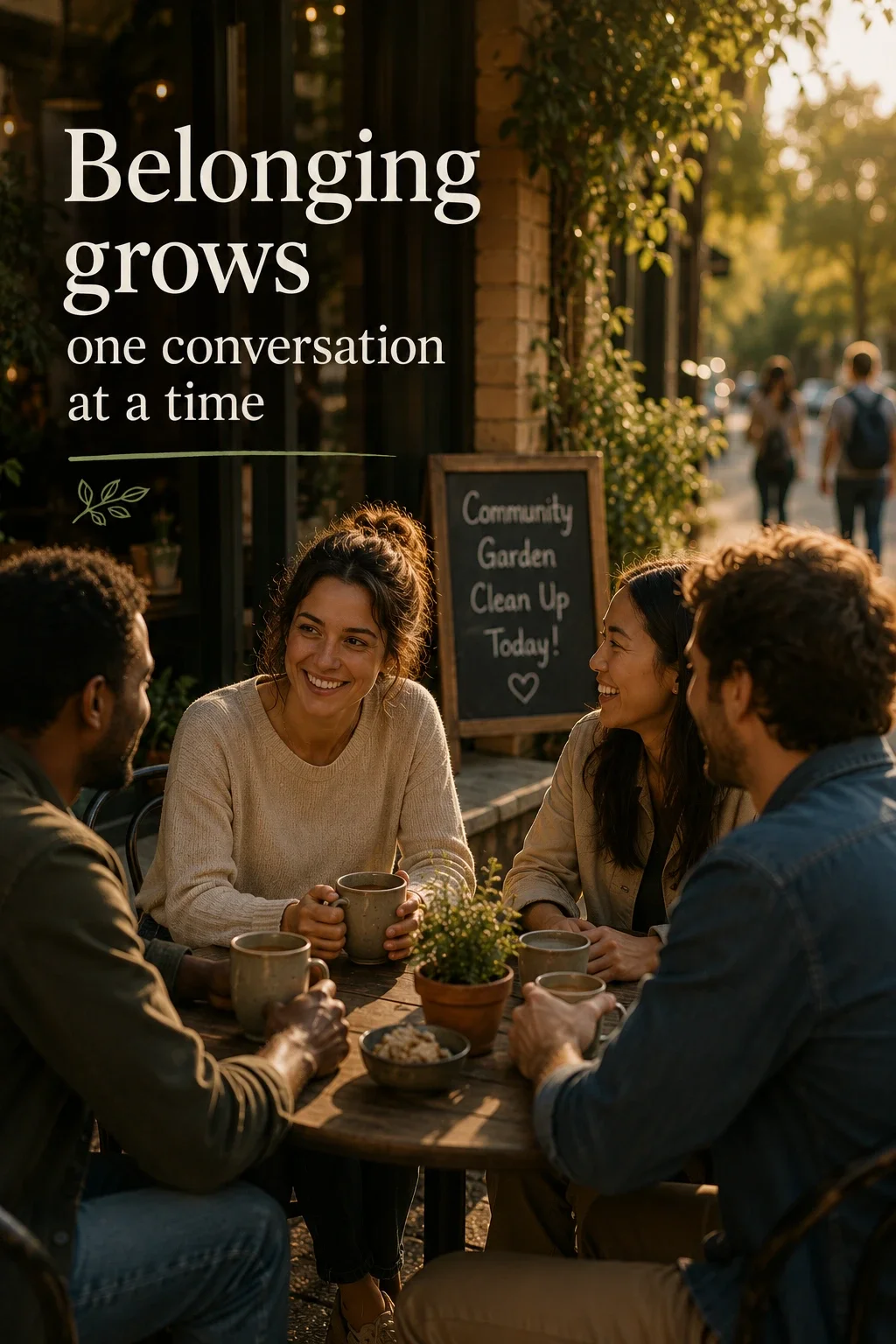
Choose a place where the same people gather regularly. A book club. A running group. A pottery class. A volunteer shift. A faith community. A choir. A walking group. A board-game night. A community garden. A pickleball league. A writing circle. A local café where regulars actually talk.
The goal is not to impress everyone in the room. The goal is to become gently familiar.
Over time, the stranger becomes “the person I’ve seen here before.” Then “the person I chatted with last week.” Then “the person I’d like to ask for coffee.” Friendship often begins not with chemistry, but with continuity.
The Return of the “Third Place”
Sociologists have long used the term “third place” to describe spaces that are neither home nor work: cafés, libraries, parks, barbershops, churches, pubs, community centres, gyms, and neighbourhood gathering spots. These places matter because they create casual belonging. You do not need a formal reason to be there. You can become known simply by returning.
In a digital age, many people are rediscovering that friendship requires more than connection; it requires place. The U.S. Surgeon General’s advisory on loneliness and social connection described social connection as a significant public health issue, linked to individual and community well-being. (HHS.gov) Pew Research Center also reported in 2025 that adults under 50 were among the groups more likely to say they often feel lonely or isolated. (Pew Research Center)
This is not just a personal problem. It is a design problem. Modern life has made many of us efficient and isolated at the same time. We can order food, stream entertainment, work remotely, bank online, shop online, and maintain relationships through fragments of messages. Convenience has reduced friction, but some friction is where human connection happens.
The third place restores a healthy kind of friction. You have to leave the house. You have to be seen. You have to return. You have to risk a little awkwardness. You have to become part of the scenery before you become part of someone’s life.
Start With One Room
The mistake many people make is trying to overhaul their entire social life at once. They download five apps, attend three events, message twenty people, and burn out.
Start smaller.
Choose one recurring room and commit to it for six to eight weeks. That timeframe matters because friendship often needs enough repeated exposure for trust to form. Hall’s research suggests that friendship development often happens over weeks and months, not in a single dramatic encounter. (Sage Journals)
Your room might be physical or digital, but it should have three qualities.
First, it should repeat. Weekly is ideal. Monthly can work, but it takes longer.
Second, it should involve shared activity. Side-by-side activities reduce the pressure of constant conversation. It is easier to talk while walking, cooking, volunteering, painting, gardening, cycling, or playing a game than while staring across a table trying to manufacture intimacy.
Third, it should reflect something you actually care about. You do not need to find your life’s passion. But you do need enough genuine interest to keep returning after the first awkward visit.
The point is not to become a social butterfly. The point is to become a regular.
The Small Skill That Changes Everything: Follow-Up
Most potential friendships do not fail because people dislike each other. They fail because no one takes the next step.
You have a good conversation in class. You laugh with someone at a volunteer event. You meet a person who seems kind. Then both of you leave, hoping vaguely that you will meet again.
Hope is not a friendship strategy.
The bridge from acquaintance to friend is follow-up. It does not need to be intense. In fact, it should usually be light.
Try this: “I enjoyed talking with you. Are you coming next week?”
Or: “You mentioned that café near the park. Would you want to check it out sometime?”
Or: “I’m going for a walk before next week’s class. You’re welcome to join.”
These small invitations matter because they move the relationship from accidental proximity to chosen connection.
There is vulnerability in that. Someone might be busy. Someone might not respond. Someone might say no. But rejection in friendship is often less dramatic than our fear makes it. Most people are navigating full lives, uncertain schedules, and their own insecurities. A declined invitation is not a verdict on your worth.
It is simply information. Try again, gently, somewhere else.

Make Friendship Easier by Making It Specific
“Let’s hang out sometime” is friendly, but weak. It asks the other person to do too much invisible labour: decide when, where, for how long, and with what level of commitment.
Specific invitations are kinder.
“Want to grab coffee after the Saturday class?”
“I’m going to the farmers’ market at 10. Want to join for half an hour?”
“A few of us are trying trivia night on Thursday. Want me to save you a seat?”
Specificity lowers the social cost. It gives people a clear door to walk through.
It also helps create the rhythm of friendship. Many adult friendships deepen through modest, repeatable rituals: a Sunday walk, a monthly dinner, a standing phone call, a shared gym class, a volunteer shift, a book exchange, a morning coffee. Grand gestures are rare. Friendship is usually built through ordinary repetition.
Digital Tools Can Help, But They Are Not the Destination
Apps can be useful, especially for people who have moved, changed life stages, work remotely, or feel disconnected from the local community. The key is to use digital tools as bridges to real interaction, not substitutes for it.
Meetup remains focused on helping people find local groups, events, and activities based on shared interests. (Meetup) Bumble BFF is designed for people seeking friendship connections nearby, with profiles and shared interests helping people start conversations. (Bumble) Partiful is widely used to create and coordinate social events, with invitations, reminders, and RSVP tools that make hosting easier. (Partiful)
The best use of these tools is simple: find the room, then leave the scroll.
Do not measure success by how many people you match with or how many events you save. Measure success by whether you showed up. Did you attend the dinner? Join the walk? Message the organizer? Return next week? Invite one person for coffee?
Technology can open the door. Friendship still requires crossing the threshold.
Be the Kind of Friend You Are Looking For
Ralph Waldo Emerson’s line, quoted in Start With One, remains one of the clearest statements on friendship: “The only way to have a friend is to be one.”
That does not mean overgiving, people-pleasing, or performing warmth you do not feel. It means practicing the qualities you hope to receive.
Be reliable. Remember details. Ask questions. Listen without preparing your next story. Celebrate small wins. Check in when someone goes quiet. Share enough of yourself to give the other person something real to know.
In Start With One, the chapter “One Minute of Listening” describes listening as a way to build a deeper connection in a distracted age. This may be one of the most overlooked friendship skills. Many people are surrounded by talk and starving for attention. A minute of sincere listening can do more than a clever introduction.
Ask: “How has that actually been for you?”
Then stay with the answer.
Reconnect Before You Restart
Making new friends does not always mean beginning from zero. Sometimes the fastest path to connection is returning to people who already mattered.
Old classmates. Former colleagues. Neighbours. Cousins. Teammates. Parents, you used to see at school pickup. Someone from a previous job. Someone you always liked but lost touch with.
Reconnection can feel awkward because we imagine we need a perfect explanation for the silence. We usually do not.
A simple message is enough: “I thought of you today and realized it’s been too long. How have you been?”
Or: “I miss our conversations. Would you like to catch up over coffee?”
Some relationships are meant to remain in the past. But others are waiting for one person to reopen the door.
This is especially useful in midlife and later life, when social circles can shrink through moves, caregiving, divorce, retirement, bereavement, or demanding work. Recent reporting on loneliness among older adults has highlighted how life transitions and shrinking social circles can contribute to isolation. (The Washington Post) Reaching back can be as powerful as reaching out.
Host Small, Not Perfect
One of the strongest ways to make friends is to become a gentle gatherer.
Not a grand host. Not someone with a flawless home, elaborate menu, or sparkling personality. Just someone willing to create a low-pressure reason for people to come together.
Invite three people for soup. Start a Sunday walk. Organize a potluck where everyone brings one thing. Create a monthly “bring a friend” coffee. Host a board-game night. Suggest a neighbourhood cleanup followed by tea. Gather people around a shared purpose rather than a polished performance.
Small gatherings work because they create the conditions for friendship: repeated presence, relaxed conversation, and shared memory.
The deeper truth is this: many people are waiting to be invited. They may look busy. They may look socially full. But modern loneliness often hides behind competence. Your invitation may be the small opening someone else needed.
Friendship Requires Courage, But Not a New Personality
Introverts do not need to become extroverted. Quiet people do not need to become entertainers. People with social anxiety do not need to throw themselves into chaotic rooms.
The better question is: what kind of connection is sustainable for you?
For some, it is a walking group rather than a loud party. For others, it is volunteering rather than small talk. For some, it is a structured class where conversation has a natural focus. For others, online communities can become meaningful, especially when they are stable, reciprocal, and built around real care. Recent research into online friendship notes that online-only friendships can be significant and long-lasting, though they come with their own challenges and social misunderstandings. (arXiv)
The goal is not to force yourself into someone else’s social style. The goal is to take one brave step that fits your life.
Send the message. Join the class. Return next week. Ask the second question. Offer the invitation.
Small social courage compounds.
The “One More Friend” Practice
Here is a simple, practical framework aligned with the Start With One philosophy.
Choose one place where you can show up weekly.
Choose one person there you would like to know better.
Ask one real question each time you see them.
Make one small invitation within the first month.
Send one follow-up message after a good conversation.
Offer one act of friendship before expecting certainty in return.
This practice is not about collecting people. It is about creating openings.
Friendship grows through signals of safety and interest: I remember you. I enjoy your company. I am willing to make time. I can be trusted with small things. I am not rushing you, but I am not disappearing either.
A Few Conversation Starters That Do Not Feel Forced
Good conversation often begins with context. Avoid trying to sound impressive. Try to sound present.
At a class: “What made you sign up for this?”
At a volunteer event: “Have you worked with this group before?”
At a hobby meetup: “How did you get into this?”
At a neighbourhood event: “Do you live nearby?”
After a good exchange: “I liked what you said about that. Can I ask you more?”
To deepen gently: “What has been bringing you joy lately?”
To invite: “I’m planning to come again next week. Want to meet a few minutes early?”
Friendship does not require perfect wording. It requires warmth, attention, and repetition.
The Real Answer: Become Findable
The best way to make new friends in 2026 is not a trick, app, or personality makeover.
It is to become findable.
Findable in places that reflect your interests. Findable on a regular schedule. Findable beyond the screen. Findable through small invitations. Findable as someone who listens, follows up, and returns.
This is both practical and hopeful. It means friendship is not reserved for the naturally outgoing or endlessly available. It belongs to those willing to take one intentional step, then another.
There is no need to build an entire social life by Friday. Start with one recurring room. One conversation. One message. One coffee. One walk. One more friend.
The work of friendship is humble. It asks us to risk being known. It asks us to make time in a culture that often rewards busyness over belonging. It asks us to notice the people already crossing our path and to become, in small ways, a person who helps others feel less alone.
That is meaningful change.
And like most meaningful change, it begins with one.
📘 Get the book: Start With One: Small Steps to a Big Change → a.co/d/5uoSTEJ
Friendship Starts Here: Sources That Inspired “What is The Best Way to Make New Friends?”
University of Kansas — How Many Hours It Takes to Make a Friend
https://news.ku.edu/news/article/2018/03/06/study-reveals-number-hours-it-takes-make-friendJournal of Social and Personal Relationships — Time Together and Friendship Development
https://journals.sagepub.com/doi/10.1177/0265407518761225U.S. Surgeon General Advisory — Our Epidemic of Loneliness and Isolation
https://www.hhs.gov/sites/default/files/surgeon-general-social-connection-advisory.pdfPew Research Center — Emotional Well-Being and Loneliness
https://www.pewresearch.org/social-trends/2025/01/16/emotional-well-being/Meetup — Find Local Groups and Events
https://www.meetup.com/Bumble BFF — Friendship Connections
https://bumble.com/en/the-buzz/what-exactly-is-bumble-bffPartiful — Social Event Planning and Invitations
https://partiful.com/Washington Post — Loneliness and Social Connection
https://www.washingtonpost.com/health/2025/12/03/loneliest-americans-aarp-survey/arXiv — Online-Only Friendships and Digital Connection
https://arxiv.org/abs/2506.20055Start With One — Source Book Inspiration
Start With One: Small Steps to a Big Change
Relevant themes: “One More Friend,” “One Minute of Listening,” and the Start With One philosophy of small, intentional action.