How Does Kindness Connect People?

How Does Kindness Connect People?
Becoming Better Humans Series 2026
Becoming Better Humans Series — By Start With One
Connection & Kindness
Deepen relationships and social impact
Includes: Random Acts of Kindness Tracker
A funny thing happens in everyday life: you can cross paths with the same people for years and still feel like strangers—or you can exchange one small kindness and suddenly everything feels warmer, safer, more human.
That’s not sentimental fluff. It’s social biology meeting lived reality. Kindness is one of the fastest ways to turn “shared space” into “shared community,” because it sends a message most people are quietly craving:
You matter here.
At a moment when public health leaders are naming loneliness as a serious global issue—linked to real health consequences—small acts of connection stop being merely “nice.” They become practical. Even protective. (World Health Organization)
This article is for anyone who wants something more than generic advice. We’ll look at how kindness actually works, why it builds connection so reliably, and how to practice it in ways that are realistic, boundaried, and sustainable—at home, at work, online, and everywhere in between.
Kindness is a social signal: “You’re safe with me”
Connection doesn’t begin with deep conversations. It begins with emotional safety—the sense that you won’t be ignored, mocked, or punished for being human.
Kindness is one of the clearest ways to signal safety because it’s a low-risk proof of goodwill. Think of the small moments that change a tone:
Someone holds the door when your hands are full
A quick message: “Just a heads-up—your package arrived”
“You look wiped. Want some quiet?”
A simple “Good morning” becomes a habit
These gestures don’t force intimacy. They create trust and openness, which makes deeper connection possible over time.
The chemistry of connection: why kindness changes how we feel
We often talk about kindness like it’s purely moral. But there’s a reason it feels connective: kindness interacts with systems in the brain and body that regulate bonding, stress, and belonging.
Medical and research overviews commonly point to oxytocin—a hormone involved in bonding and trust—as one pathway through which warm social behaviors can strengthen connection. (Harvard Medicine Magazine)
In other words, kindness doesn’t just mean something. It can change what your nervous system believes is possible with other people.
There’s also evidence that prosocial behavior (including gratitude and caring actions) supports relationship investment and bond-strengthening processes—part of the “this person is good for me” internal math humans do constantly. (PMC)
Translation for real life: Kindness makes connection feel safer and more rewarding—both for the giver and receiver. That’s why it becomes easier to keep showing up once the pattern begins.
Small acts matter more than we think (and the data backs it)
One of the most useful findings for modern life is this: you don’t need grand gestures. In fact, small, consistent kindness tends to be the most scalable—and the most connective.
A BYU-led study reported that one act of kindness per week was associated with reduced loneliness and social anxiety, and improved community connection. (BYU News)
A University of Toronto news release summarizing research in Journal of Happiness Studies points to daily acts of kindness as a practical way to reduce loneliness and increase social interaction. (Faculty of Arts & Science)
Community-focused research like the KIND Challenge has explored kindness as a scalable approach to improving loneliness and neighborhood cohesion. (PMC)
Key insight: Small is powerful because small is repeatable. Repeatable becomes culture.
The ripple effect: how one kind act spreads
Kindness is contagious in the most ordinary way: it resets expectations.
When one person offers a moment of care, it quietly introduces a new social norm:
This is a place where people look out for each other.
That’s how communities become resilient—not through slogans, but through repeated micro-evidence.
This matters because social connection isn’t just a “nice-to-have.” The World Health Organization has emphasized that social connection supports health, while loneliness and isolation raise risks across physical and mental health outcomes. (World Health Organization)
Think of the ripple:
One person returns a misdirected message instead of ignoring it
Another begins saying hello more often
Someone offers help without making it a big deal
A group shifts from “avoid eye contact” to “we’ve got each other”
That’s culture change—without a committee, without perfection.

Bridging divisions without becoming a doormat
Kindness is not passivity. And it’s not “being agreeable.” In tense moments, kindness can be a way to preserve dignity while still holding boundaries.
Example: conflict with backbone
Instead of: “You’re always disrespectful.”
Try: “Hey—quick note. I’m having trouble focusing with the noise after 10pm. Could we keep it down then? I’d really appreciate it.”
That’s kindness with backbone: clear, respectful, specific.
Kindness also includes self-kindness. If you’re always the one giving, you’re not building community—you’re building resentment. The goal is connection, not depletion.
Practical kindness: what actually works (without overcommitting)
Here are acts that build connection without draining you:
1) The “two-sentence check-in”
“Hey—hope your week’s going okay. If you need anything small, I’m around.”
Low pressure. High warmth.
2) The “small notice”
“Just a heads-up—your package arrived.”
“This link might help you—thought of you.”
Kindness as information builds trust fast.
3) The “repair the social fabric” move
If there’s tension, aim for a solution, not a winner:
“Could we try quiet hours after 10?”
“Want to swap numbers in case of mix-ups?”
4) Micro-recognition
People feel connected when they feel seen:
“Congrats—I’m genuinely happy for you.”
“You handled that well.”
5) Community kindness that doesn’t require extroversion
Share one helpful tip. Offer one useful item. Leave one encouraging comment.
Small, steady contributions create belonging.
Actionable takeaways you can apply today
Choose one—small enough you’ll actually do it:
Make eye contact + say a name once this week (“Morning, Sam.”)
Send one check-in text: “How’s your week?”
Offer one practical assist (hold a door, carry something, share a resource)
Repair one friction point with respectful clarity
Practice self-kindness as a boundary: “No, I can’t—but I hope it goes well.”
If you’re thinking “this is too small to matter,” that’s exactly why it works.
Small is repeatable. Repeatable becomes culture.
Random Acts of Kindness Tracker 2026
Connection & Kindness — Deepen relationships and social impact
Tracking turns good intentions into a visible pattern—especially in busy months.
Step 1: Pick your categories (simple, human, complete)
Personal (family, friends, partners)
Work & professional (colleagues, clients, service providers)
Community (neighbors, local businesses, volunteering, online spaces)
Self-kindness (rest, boundaries, health, self-talk)
Step 2: Use a tracker you’ll actually keep
Paper: 4 rows × 7 columns. One short line per act.
Notes/spreadsheet: Date | Category | What I did | Connection impact
Monthly reflection: What created real connection? What drained me? What felt natural?
Step 3: Choose your 2026 minimum (realistic + evidence-friendly)
Minimum effective dose: 1 intentional act/week aimed at connection. (BYU News)
Ideal: 1 micro-kindness/day (under 2 minutes) + one deeper act/week. (Faculty of Arts & Science)
Monthly questions (keep it journalist-simple):
Which relationships feel warmer?
Where did kindness reduce friction?
What did I learn about what people actually need?
Where do I need stronger boundaries?
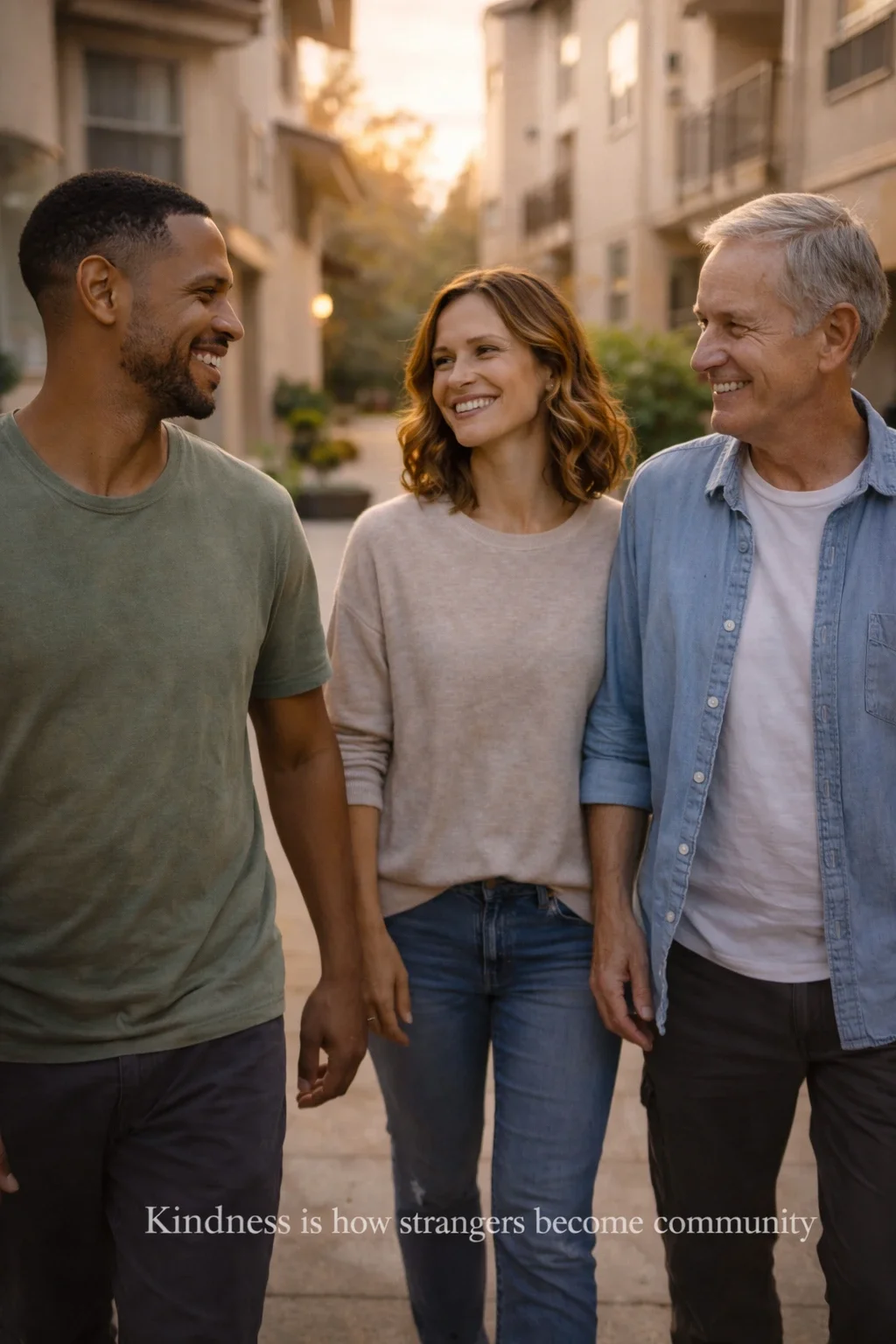
Conclusion: kindness is how strangers become a community
Kindness connects people because it builds safety, belonging, and mutual value—in relationships and in the wider community. And right now, in a world where loneliness is being treated as a serious public health concern, it’s also a quietly radical practice. (World Health Organization)
You don’t control everything—timing, stress, other people’s moods, the pace of modern life.
But you do control the small moments that determine whether your world feels cold or connected.
So start where connection always starts:
One small act. Repeated. With intention.
That’s how kindness stops being an idea—and becomes a living culture.
🔗 Kindness That Connects: Your Research Link Pack (Start With One)
WGBH — Random acts of kindness, social connection, loneliness
https://www.wgbh.org/news/national/2023-05-12/random-acts-of-kindness-can-increase-social-connection-and-help-combat-lonelinessBioneurix — How kindness affects others (trust, openness, community)
https://bioneurix.com/blogs/blog/how-does-kindness-affect-othersBYU News — One act of kindness per week improves wellbeing + community
https://news.byu.edu/byu-study-shows-that-even-one-act-of-kindness-per-week-improves-wellbeing-for-individuals-communitiesThe Be Kind People Project — The science of kindness (bonding + reciprocity)
https://thebekindpeopleproject.org/blog/2024/11/13/the-science-of-kindness/Narayan Seva USA — Why random acts of kindness build stronger communities
https://www.narayansevausa.org/why-random-acts-of-kindness-day-matter-in-building-stronger-communities/Abundance Therapy Center — How random acts of kindness promote mental wellbeing
https://www.abundancetherapycenter.com/blog/how-random-acts-of-kindness-promote-mental-well-beingHoney Foundation — Research info on kindness (endorphins/oxytocin/cortisol + health)
https://www.honeyfoundation.org/research-info/BeKind App — Kindness tracking + ideas
https://www.beekind.appGoogle Play — BeKind app listing
https://play.google.com/store/apps/details?id=app.bekind.bekind&hl=en_CAApple App Store — Kindness Tracker app listing
https://apps.apple.com/us/app/kindness-tracker/id6749832707