How Exactly Do You Meditate?
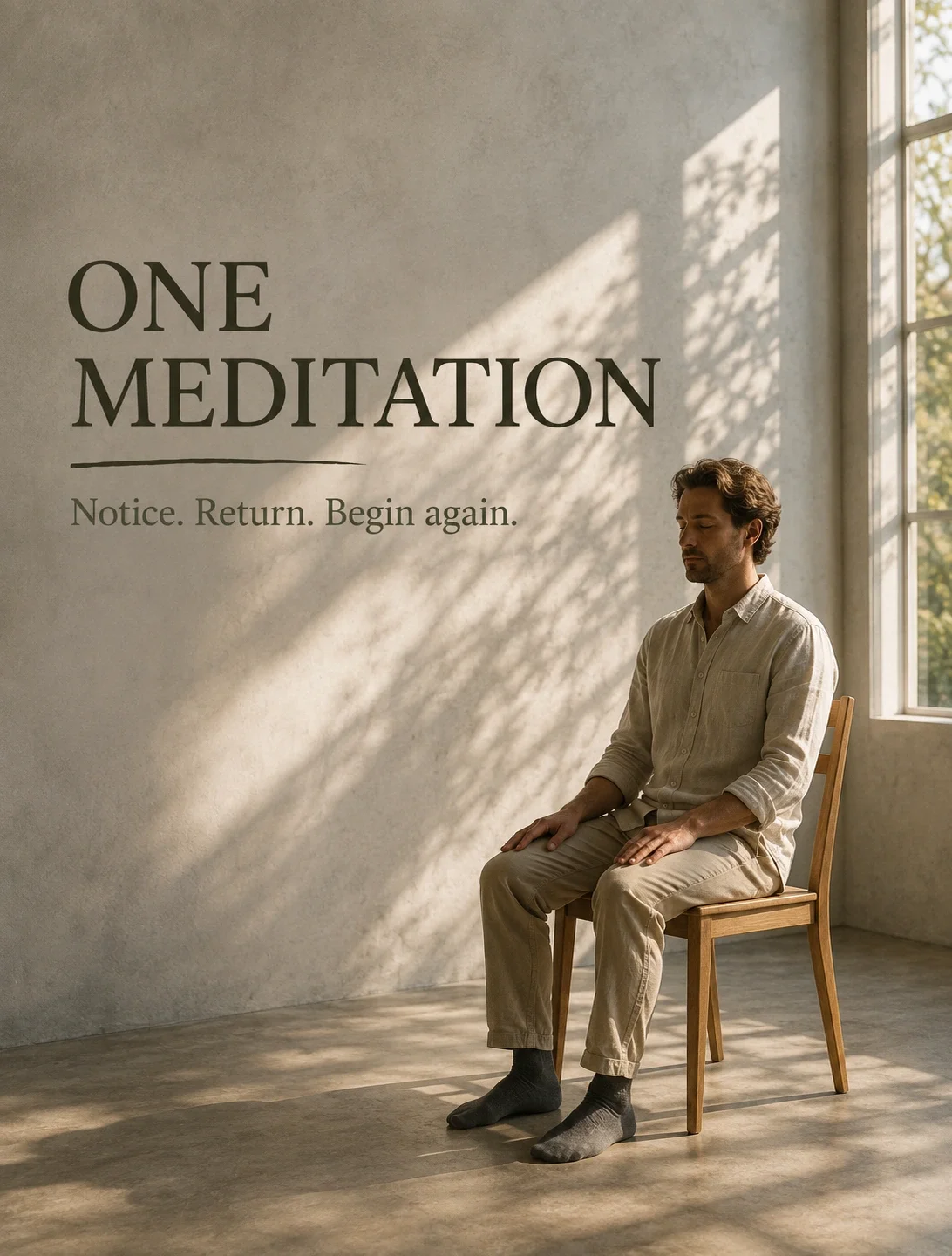
How Exactly Do You Meditate?
One Meditation: The Gateway to Inner Peace and Clarity
To meditate, sit comfortably, choose one object of attention—usually your breath—notice when your mind wanders, and gently return. That is the practice. Meditation is not about forcing your mind to go blank. It is about training awareness, one return at a time.
A beginner often imagines meditation as something difficult: a silent room, perfect posture, deep calm, and a mind without thoughts.
Then they try it.
Within seconds, the mind moves.
An email.
A memory.
A sound
A plan.
A worry.
A question: Am I doing this wrong?
That is usually when people think they have failed.
But that moment is not failure.
That moment is meditation beginning.
Meditation is the practice of noticing that your attention has wandered and bringing it back with patience. Mayo Clinic describes mindfulness meditation as focusing on one thing, such as the breath, while observing thoughts and emotions without judgment. (Mayo Clinic)
The Start With One approach makes meditation simple: focus on the breath, embrace the present moment, and seek out quiet spaces that help the practice feel possible.
Not a perfect mind.
Not a perfect routine.
One breath.
One minute.
One return.
What Is Meditation?
Meditation is a practice of training attention and awareness.
In the simplest version, you choose something to notice, your breath, body, a sound, a phrase, or the sensation of walking, and return to it whenever the mind drifts.
Meditation can be spiritual, secular, religious, therapeutic, or simply practical. Some people use it for prayer. Some use it to reduce stress. Some use it to become less reactive. Some use it to create a calmer beginning to the day.
The method can vary.
The core movement is often the same:
Notice. Return. Begin again.
How Exactly Do You Meditate?
Step 1: Sit Somewhere Quiet Enough
You do not need perfect silence.
Choose a place where you can sit for a few minutes without needing to respond to anything immediately.
That might be:
A chair beside your bed
A quiet corner of the living room
Your parked car
A bench outside
A private office
The edge of your bed before checking your phone
The space does not need to look peaceful.
It needs to be usable.
Step 2: Get Comfortable
Sit in a chair with both feet on the floor, or sit on a cushion if that feels natural.
Keep your back upright but not stiff. Rest your hands in your lap or on your legs. Relax your jaw. Let your shoulders drop.
You do not need to sit cross-legged. You do not need to look like an image of meditation. You only need a posture that lets you stay alert without straining.
If sitting is uncomfortable, lying down or walking slowly can also work.
Step 3: Set a Short Timer
Start with one to five minutes.
That may sound too short, but short practices are easier to repeat. A one-minute meditation done consistently is more useful than a 30-minute plan you abandon.
Use a gentle timer. Put your phone on Do Not Disturb if possible.
Once the timer starts, your only job is to notice.
Step 4: Focus on Your Breath
Close your eyes if that feels comfortable. If not, soften your gaze and look slightly downward.
Breathe normally.
Do not force the breath. Do not try to perform calm.
Simply notice where breathing is easiest to feel:
Air moving through your nostrils
The rise and fall of your chest
The movement of your belly
The feeling of your body breathing
Mayo Clinic identifies breath focus as one of the common elements of meditation. (Mayo Clinic)
If it helps, quietly say:
Breathing in.
Breathing out.
Or count:
Inhale: one
Exhale: two
Continue to ten, then begin again.
Step 5: Notice When Your Mind Wanders
Your mind will wander.
That is normal.
When you notice a thought, silently name it:
Thinking.
Planning.
Remembering.
Worrying.
Then return to the breath.
Do not argue with the thought. Do not punish yourself for having it. Do not decide you are bad at meditation.
The return is the practice.
Just as one push-up trains the body, one return trains attention.
Step 6: Close Slowly
When the timer ends, do not immediately grab your phone.
Take one final breath.
Notice:
How your body feels
What sounds are around you
Whether your mind feels different
What one quality you want to carry into the next moment
Then open your eyes or lift your gaze.
Meditation should not feel like escaping your life.
It should feel like returning to it with more awareness.
What Should I Think About While Meditating?
You do not need to think about anything on purpose.
In breath meditation, your job is to feel the breath, not manage every thought.
Thoughts will appear. Let them.
Notice them like passing weather. Name them if helpful. Then return to your anchor.
Meditation is not a war against thinking.
It is the practice of no longer being pulled away by every thought that appears.
How Long Should Beginners Meditate?
Beginners should start with one to five minutes.
After a week, increase to seven or ten minutes only if the practice feels sustainable. Longer sessions can be useful, but consistency matters more than duration.
A simple progression:
Week 1: 1 to 3 minutes
Week 2: 5 minutes
Week 3: 7 to 10 minutes
Later: 10 to 20 minutes if desired
The goal is not to become impressive.
The goal is to become consistent.
What Are the Benefits of Meditation?
Meditation may help some people reduce stress, improve emotional awareness, support attention, improve sleep, and cope with anxiety or pain. The National Center for Complementary and Integrative Health notes that mindfulness and meditation research is promising in several areas, while also emphasizing that evidence quality varies and meditation should not be treated as a cure-all. (NCCIH)
The American Psychological Association also reports that mindfulness-based approaches have been associated with reduced stress, anxiety, and depression in some research. (American Psychological Association)
The honest promise is this:
Meditation may not make life easier.
It may help you meet life with less automatic reaction.

What If I Cannot Stop Thinking?
Then you are having a normal meditation session.
The mind produces thoughts. That is what minds do.
The purpose of meditation is not to shut the mind off. The purpose is to recognize thoughts as thoughts and return to the present moment.
You may return once.
You may return 100 times.
Every return counts.
What If Breath Meditation Feels Hard?
Breath meditation is common, but it is not the only option.
Try a different anchor.
Body Scan Meditation
Move attention slowly from feet to head. Notice pressure, warmth, tension, tingling, heaviness, or ease.
Walking Meditation
Walk slowly and notice each step. Feel the heel, sole, and toes. Let movement become the anchor.
Guided Meditation
Listen to a teacher or audio guide. This can help beginners who want structure.
Mantra Meditation
Repeat a calming word or phrase silently.
Examples:
Here.
Now.
Peace.
Breathing in, breathing out.
Box Breathing
Inhale for four counts.
Hold for four.
Exhale for four.
Hold for four.
Cleveland Clinic notes that there are many ways to meditate and that beginners do not need to force the mind to become completely quiet. (NCCIH)
The best style is the one you will actually practise.
A Simple 3-Minute Meditation Script
Use this right now.
Sit comfortably.
Let your hands rest.
Take one natural breath in.
Let one natural breath out.
Feel your body supported.
Bring attention to your breathing.
Notice where the breath is easiest to feel.
Maybe the nostrils.
Maybe the chest.
Maybe the belly.
You do not need to change the breath.
Just notice this inhale.
This exhale.
When your mind wanders, gently say:
Thinking.
Then return to the next breath.
Again:
Inhale.
Exhale.
Nothing to fix.
Nothing to prove.
Nowhere else to be for this moment.
If you feel restless, notice restlessness.
If you feel calm, notice calm.
If you feel distracted, notice distraction.
Then return.
One breath.
One moment.
One return.
When you are ready, open your eyes.
Before moving on, ask:
What is one quality I want to bring into the next part of my day?
That is meditation.
Common Beginner Mistakes
Expecting the Mind to Go Blank
A blank mind is not required. Wandering and returning are part of the practice.
Starting Too Big
One minute is enough to begin. Keep the practice small enough to repeat.
Judging the Session
Some sessions feel calm. Others feel scattered. Both count.
Practising Only When Stressed
Meditation can help during stress, but it becomes more available when practised before crisis.
Using Meditation to Avoid Life
Meditation should help you respond to life, not avoid difficult conversations, decisions, or responsibilities.
Ignoring Serious Distress
Meditation is not a substitute for medical or mental-health care. If meditation increases panic, trauma symptoms, dissociation, hopelessness, or distress, pause and seek qualified support.
A Start With One Meditation Plan
Try this for seven days.
Day 1: One Breath
Take one intentional breath before checking your phone.
Day 2: One Minute
Sit for one minute and notice your breathing.
Day 3: One Return
When the mind wanders, return once without judgment.
Day 4: One Quiet Space
Choose a regular place to practise.
Day 5: One Body Scan
Notice sensations from feet to head.
Day 6: One Walking Meditation
Take ten slow steps and feel each one.
Day 7: One Reflection
After meditating, ask: What changed, even slightly?
This is how meditation becomes real.
Not as an identity.
Not as a performance.
As one small practice you can repeat.
Frequently Asked Questions
How exactly do you meditate?
Sit comfortably, set a short timer, focus on your breath or another anchor, notice when your mind wanders, and gently return. You are not trying to stop thoughts. You are practising awareness.
What should I focus on while meditating?
Beginners often focus on the breath. You can notice air at the nostrils, the rise and fall of the chest, the movement of the belly, sounds, body sensations, steps, or a repeated phrase.
How long should beginners meditate?
Start with one to five minutes. Increase slowly only if the habit feels sustainable. Consistency matters more than long sessions.
Am I meditating wrong if I keep thinking?
No. Thinking is normal. Meditation includes noticing that the mind wandered and returning to the breath or anchor.
Should I meditate with eyes open or closed?
Either is fine. Close your eyes if it helps. Keep a soft downward gaze if closing your eyes makes you sleepy, uncomfortable, or distracted.
What type of meditation is best for beginners?
Mindfulness breath meditation is one of the simplest places to start. Guided meditation, body scans, walking meditation, and mantra meditation can also work well.
One Meditation Is Enough to Begin
You do not need a silent retreat, a perfect room, a special cushion, or a mind that never wanders.
You need one honest pause.
One place to sit.
One breath to feel.
One thought noticed.
One gentle return.
One minute in which you stop running from your own life.
The world will still be loud.
Your responsibilities will still be waiting.
Your mind will still make noise.
But something changes when you learn that you can return.
To the breath.
To the body.
To the moment.
To yourself.
Start With One meditation. Inner peace begins with one return.
Get the book: Start With One: Small Steps to a Big Change → a.co/d/5uoSTEJ

One Breath at a Time: Sources Behind “How Exactly Do You Meditate? 2026”
Mayo Clinic — Meditation: A Simple, Fast Way to Reduce Stress
https://www.mayoclinic.org/tests-procedures/meditation/in-depth/meditation/art-20045858Mayo Clinic — Meditation: Overview and Common Elements
https://www.mayoclinic.org/tests-procedures/meditation/about/pac-20385120National Center for Complementary and Integrative Health — Meditation and Mindfulness: Effectiveness and Safety
https://www.nccih.nih.gov/health/meditation-and-mindfulness-effectiveness-and-safetyAmerican Psychological Association — Mindfulness Meditation
https://www.apa.org/topics/mindfulness/meditationCleveland Clinic — How to Meditate and Top Benefits
https://health.clevelandclinic.org/how-to-meditate-and-top-benefitsMindful — How to Meditate
https://www.mindful.org/how-to-meditate/Wired — How to Meditate
https://www.wired.com/story/how-to-meditate/Headspace — Meditation for Beginners
https://www.headspace.com/meditation/meditation-for-beginnersUniversity of Toronto Mississauga — Mindfulness and Meditation Resources
https://www.utm.utoronto.ca/health/health-promotion/mindfulness-meditationStart With One — Source Book Inspiration
Start With One: Small Steps to a Big Change
Relevant theme: “One Meditation: The Gateway to Inner Peace and Clarity”